
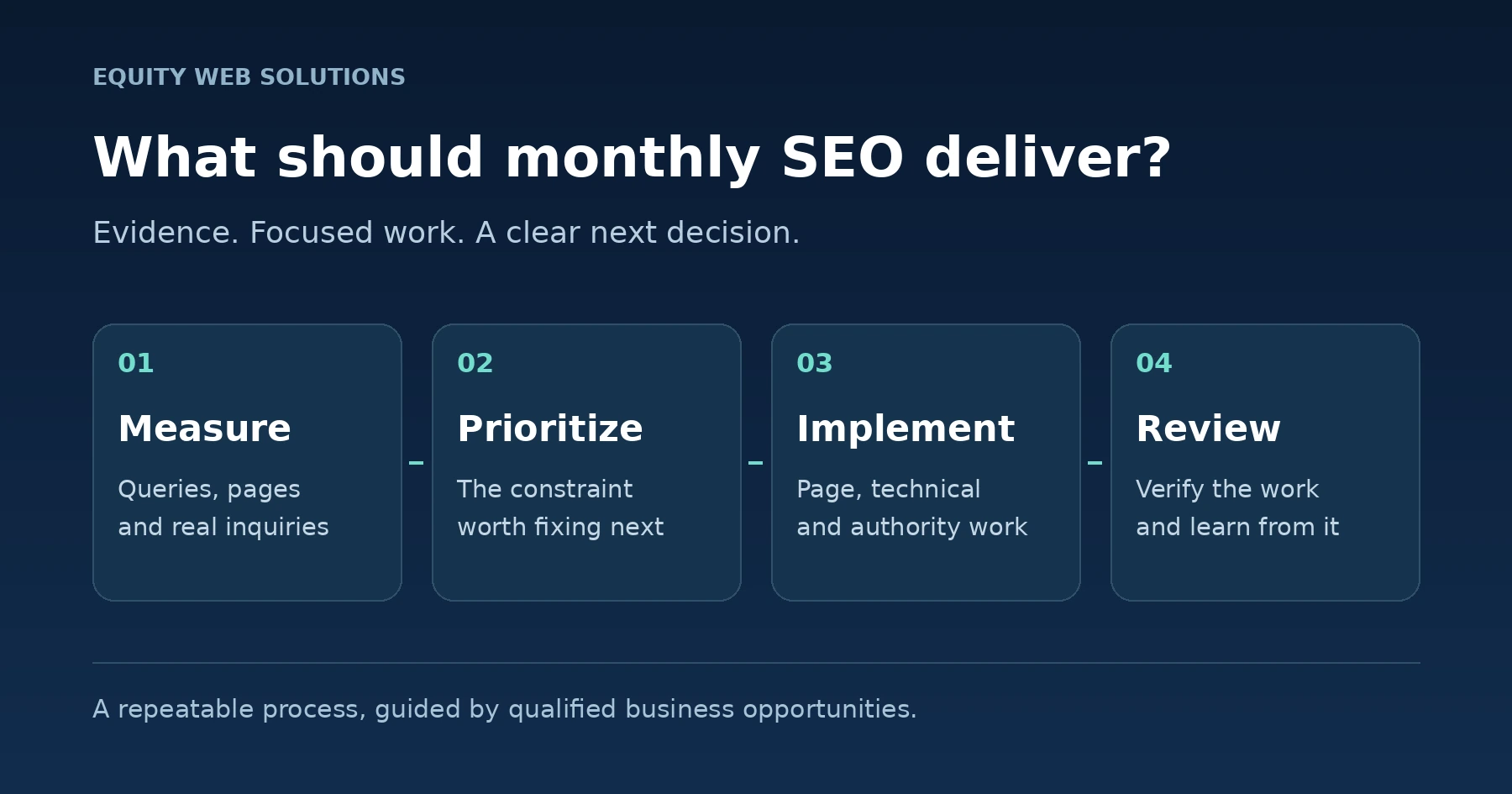
An SEO company should turn search evidence into a focused plan, carry out the agreed improvements, verify the work and explain what happened next. Each month, you should be able to see which business opportunities received attention, which pages changed and what the provider learned. A dashboard by itself does not tell you whether the work is useful.
Monthly SEO should include performance analysis, a prioritized work plan, technical monitoring, improvements to important pages, useful internal links, credible authority building and a review of inquiries. The mix should follow the website’s actual constraints. It should not default to the same article quota, backlink count or automated audit every month.
Evaluating an ongoing SEO service? Our Strategic SEO services for San Diego businesses connect commercial searches, service pages, authority and qualified inquiries.
What should you receive from an SEO company each month?
Ask for evidence you can inspect. The following checklist is a practical standard for discussing scope, not a fixed list Google requires every agency to complete each month.
| Workstream | Evidence to request | Business question |
|---|---|---|
| Search performance | Comparable dates, exact queries, owning pages and relevant location filters | Are suitable buyers finding the right services? |
| Priorities | A short plan with a reason, owner and review date for each action | Why is this the best use of the budget now? |
| Technical health | Confirmed problems, affected URLs, fixes and validation | Can important pages be discovered and used? |
| Page improvements | Changed URLs and examples of better service detail, proof or navigation | Does the page answer the buyer’s decision? |
| Content and links | A clear purpose for each article and its links to the appropriate service | Does this support demand for work we want? |
| Authority and local proof | Relevant mentions, honest reviews, case evidence and accurate profiles | Can customers verify why they should trust us? |
| Lead measurement | Completed inquiries, source information and qualification where known | Is search contributing to real opportunities? |
| Decisions and reporting | Work completed, results, limitations and the next agreed actions | What should continue, change or stop? |
1. Review the searches and pages that matter to your business
The review should start with services you can profitably deliver and the customers you want to attract. For an established San Diego business, growth in unrelated searches from other markets may have little commercial value. An agency should explain which queries indicate a buyer, which are research questions and which are too ambiguous to guide a decision.
Ask to see the exact query and the page appearing for it. A service page’s average position combines many searches; it is not the ranking of one important keyword. The report should also distinguish branded searches from people discovering the company for the first time.
Compare consistent date ranges and acknowledge small samples. A query with three impressions is a lead to investigate, not a reliable forecast of customers. Fewer impressions can accompany a better average position when the mix of searches changes. Our guide to why SEO reports are not enough explains how reporting becomes useful only when it changes a decision.
2. Set a short work plan with clear ownership
A useful monthly plan names the affected page or system, the evidence behind the action, the person responsible and when the result will be reviewed. It should separate tasks the agency implements from tasks requiring your team, developer or approval.
For example, an agency might recommend improving one high-value service page before producing another general article. That recommendation should identify the missing information or buyer-path problem, rather than rely on a vague promise to optimize the page. Use page-level SEO priorities to connect the work to commercial value and implementation effort.
You should also know what will be left alone. Rewriting a relevant page every time its position fluctuates makes it harder to learn whether previous work helped. Monitoring a recent change can be an appropriate decision when the reason and review date are documented.
3. Fix technical problems that affect important pages
Technical monitoring should focus on actual consequences: an important service page excluded from indexing, an incorrect canonical, a broken redirect after a redesign or a mobile contact form that fails. A long list of tool warnings does not automatically mean the website has a long list of urgent problems.
Ask which URLs are affected, how the problem was confirmed and what was checked after the fix. An audit recommendation is different from an implemented correction. If a developer must do the work, the agency should make that dependency clear and verify completion.
Performance and usability belong in this conversation when they obstruct the visitor or affect important pages. They should not become a monthly contest to eliminate every harmless warning while a broken inquiry path remains unresolved.
4. Improve service pages before adding content for its own sake
A service page needs to explain who the service is for, the problem it solves, what the work includes, why the business is credible and how an interested visitor can take the next step. Useful improvements might include clearer scope, specific client evidence, relevant questions, better navigation or a more usable contact path.
Supporting articles should answer a distinct buyer question and connect readers to the appropriate service. A website-cost guide can help someone plan a project; the web design service page should remain the destination for evaluating the provider. Publishing another page targeting the same service-buying phrase can make that relationship less clear.
There is no universal requirement to publish a fixed number of posts each month. The plan should explain when a new article fills a genuine gap and when strengthening an existing service page is the more useful action.
5. Build credible proof and authority outside the dashboard
Authority work should connect the website to evidence of a real, credible business. Depending on the engagement, that can include documenting client projects, improving founder information, pursuing relevant local or industry mentions and keeping important business profiles accurate. Our Website Authority approach covers this supporting evidence layer.
For local businesses, an agreed review process and Google Business Profile maintenance may be part of the scope. Clarify what the agency does and what your team supplies. Reviews must come from real experiences; an agency should never manufacture customers or invent case-study results.
For links, ask where they come from and why the relationship is relevant. A package promising hundreds of low-quality links is not a substitute for credible exposure. Google identifies manipulative link practices and large-scale low-value content as spam risks. No provider can guarantee that an external publisher will feature your business on demand.
6. Connect reporting to completed, qualified inquiries
The agency should verify what its conversion numbers actually mean. A submitted form is not automatically a qualified lead. A booking-page click is not a confirmed appointment, and a phone-button click does not prove a conversation occurred.
Pair analytics with a simple lead record: service requested, source where known, location or service fit, qualification and eventual outcome. Separate duplicates, spam and existing-customer messages. When attribution is missing, report it as unknown rather than assign every inquiry to SEO.
Low traffic also needs honest interpretation. A handful of visitors cannot establish a dependable conversion rate. First determine whether relevant people are arriving, then assess whether the page helps them inquire. Read why rankings and being chosen are different problems for that distinction.
A monthly decision record
Evidence → action → verification → next decision
Every meaningful task should have a visible thread from the business problem to the work performed and the next review. This makes the relationship accountable even when results need time to develop.
Illustrative example, not a client result
How a useful monthly update sounds
Finding: A relevant service page appears for buyer searches, but inquiries remain scarce. Its mobile form has an error and its project examples do not explain the work.
Action: Repair the form, validate a completed submission and add a documented project example. Keep the page’s primary search intent intact.
Next review: Confirm the form works immediately, then review relevant landing visits and qualified inquiries over a comparable period. A later increase would be promising, but would not prove which change caused it.
What should change between the first month and ongoing SEO?
The first month commonly involves access, measurement checks, a baseline, technical diagnosis and agreement on priorities. Later months should show implementation, verification and decisions based on what has been learned. Repeating the same initial audit without resolving its important findings deserves an explanation.
The work will vary. A migration may require technical attention; an established site may need better service proof or stronger authority. Ask whether an audit, implementation and ongoing management are included separately. The signed scope should make those responsibilities clear.
Google’s hiring guidance encourages owners to ask about previous work, expected results, communication and the reasoning behind recommendations. It also warns against ranking guarantees. Use those questions to evaluate the provider’s judgment, rather than treating a busy task list as evidence of success.
Questions to ask at your next SEO review
- Which services and buyer searches are we prioritizing? Ask for the owning pages, not just a sitewide visibility score.
- What changed on the website this month? Request URLs, completed work and validation.
- What did we learn about real inquiries? Separate analytics events from qualification and sales outcomes.
- Which proof or authority gaps still need our help? Your team may need to supply project details, approvals or customer introductions.
- What will happen next, and why? Expect a priority, owner and review date, including a reason for leaving recent changes alone.
Frequently asked questions
What is included in monthly SEO services?
The scope commonly combines analysis, planning, technical checks, page improvements, supporting content, authority work and reporting. Confirm which tasks are implemented by the provider and which require your team. The mix should follow the business’s needs and agreed budget.
Should an SEO company create new content every month?
Only when it serves a defined purpose. Updating an existing page, documenting a client example or fixing a technical blocker may be more useful than another article. Ask what each proposed piece supports and whether an existing page already answers the question.
How long should you wait before judging SEO work?
Verify completed tasks and tracking promptly. Search effects can take weeks or months, and not every change creates measurable growth. Agree on review dates and leading indicators while continuing to check relevant traffic and qualified inquiries.
Can an agency guarantee page-one rankings or leads?
No provider controls Google’s results or whether every visitor becomes a customer. An agency can commit to an agreed scope, transparent work and measurement. Treat guaranteed rankings or an unexplained promise of leads cautiously.
Equity Web Solutions helps established San Diego service businesses connect search evidence, commercial pages, credible proof and qualified demand. Book a Visibility Review to identify the most useful next step for your website and SEO priorities.
Primary sources
Google guidance checked October 21, 2026. The monthly checklist and illustrative decision record are Equity Web Solutions’ practical framework, not a Google-prescribed service package.