
Demand
Focus budget on searches, services, locations, and audiences with stronger commercial intent.
- Campaign and keyword structure
- Search-term and negative-keyword control
San Diego PPC Management
Capture high-intent demand without wasting budget on weak searches, poor-fit clicks, or unreliable conversion data.
Equity Web Solutions connects campaign strategy, search-term control, ad messaging, geographic targeting, landing pages, tracking, and lead-quality review as one paid-search system.
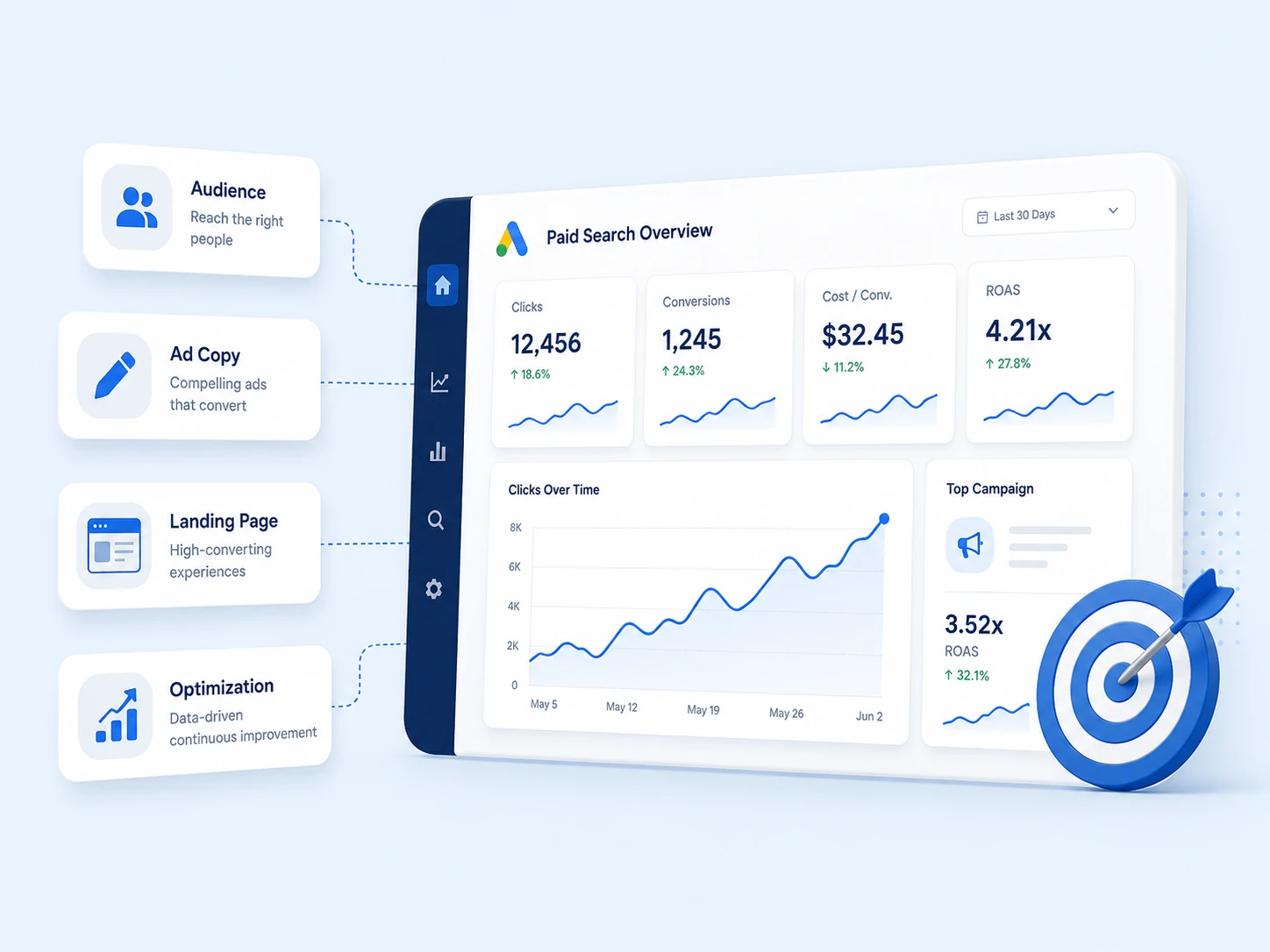
Strategic principle
Google can deliver traffic. Qualified demand depends on choosing the right searches, presenting the right message, sending visitors to the right page, and measuring what happens after the click.
Paid-search system
The priorities depend on search demand, competition, geography, offer strength, landing-page quality, tracking, and the economics of each qualified lead.
Focus budget on searches, services, locations, and audiences with stronger commercial intent.
Match the ad, offer, and call to action to what the buyer is trying to solve.
Connect each click to a relevant page that answers questions, builds trust, and creates a clear next step.
Use calls, forms, bookings, revenue signals, and lead-quality feedback to guide optimization.
Paid-search economics
The value of a campaign is shaped by the full path from available demand to profitable customers. Improving one metric in isolation can make reporting look better while business performance stays flat.
How much relevant buyer intent exists for the service, location, and offer.
What it costs to reach that demand after targeting, competition, and quality are considered.
How effectively the ad, landing page, trust signals, and next step turn visits into inquiries.
Whether calls, forms, and bookings match the services, geography, and customer profile the business wants.
Whether acquired customers produce enough revenue and margin to support the cost of acquisition.
Where paid search breaks down
An account can look active while the underlying targeting, conversion path, or measurement system quietly weakens lead quality and budget efficiency.
Budget reaches searches, locations, devices, or audiences that do not match the service or buyer intent closely enough.
The ad attracts attention, but the offer, landing page, mobile experience, or next step does not convert enough qualified visitors.
Calls, forms, bookings, and lead quality are not tracked reliably enough to show what should be scaled, corrected, or stopped.
Google Ads methodology
Each stage connects the account, message, landing page, tracking, and lead-quality feedback before more budget is committed.
Diagnose
Review campaigns, search terms, geography, devices, ads, landing pages, conversion tracking, and actual lead quality.
Prioritize
Separate wasted spend, tracking errors, weak offers, poor-fit traffic, and high-intent opportunities by likely business impact.
Build and test
Improve structure, targeting, exclusions, ads, landing-page relevance, call tracking, and conversion events through controlled tests.
Optimize and scale
Use search-term, conversion, cost, and lead-quality data to refine bids, budgets, messaging, and campaign expansion.
Documented Google Ads result
For Turnt Up Tours, campaign restructuring, search-term cleanup, placement exclusions, ad testing, landing-page alignment, and conversion tracking helped turn Google Ads into a measurable acquisition channel.
“The goal is not to make the ad account look busy. It is to make the relationship between spend, qualified demand, and revenue easier to understand.”
This documented result does not establish that every campaign, market, or business will produce the same return. Performance varies by offer, margins, competition, budget, tracking quality, landing pages, sales follow-up, and campaign history.
Best fit
PPC can be a strong fit when buyers are already searching for your services and you need a faster path to visibility while SEO and AI visibility build over time.
Google Ads FAQs
Clear answers about timing, landing pages, lead quality, tracking, suspicious traffic, budgets, and what responsible Google Ads management can influence.
Management can include account structure, keyword and search-term research, negative keywords, ad creation, San Diego and service-area targeting, budget allocation, conversion and call tracking, landing-page review, lead-quality analysis, and ongoing optimization.
Campaigns can begin generating traffic soon after launch, but reliable optimization requires enough conversion and lead-quality data to distinguish productive searches from wasted spend. Timing varies by demand, competition, budget, offer, landing page, and sales follow-up.
Poor leads often come from broad targeting, weak negative-keyword control, misleading search intent, geographic leakage, generic landing pages, or optimization around form submissions rather than qualified business outcomes.
Not always, but paid traffic should reach a page that closely matches the search, offer, location, proof, and next action. A generic homepage often weakens relevance, conversion rate, and lead quality.
The review can examine search terms, click patterns, geography, devices, placements, conversion behavior, call quality, form quality, and platform invalid-traffic reporting. Not every poor click is fraudulent, so conclusions should be based on evidence rather than assumptions.
Budget should reflect available search demand, click costs, conversion rate, lead quality, customer value, margins, and the amount of data needed to make decisions. Spending more is justified only when tracking and economics support it.
Useful measurement can include qualified calls, forms, bookings, revenue, cost per qualified lead, conversion rate, search-term quality, geographic performance, and customer value—not clicks or platform conversions alone.
PPC may not make sense when margins cannot support acquisition costs, tracking is absent, the offer is weak, the service area is too narrow, relevant search demand is limited, or the website cannot convert the traffic.
Related insights
Practical explanations that connect the service to search intent, buyer trust, and measurable business decisions.
Google Ads can create faster, controlled visibility. SEO can build durable organic demand. The right first investment depends on urgency, economics, search demand, website readiness, tracking, and sales capacity.
Read article Google AdsProfessional Google Ads management should connect strategy, search terms, targeting, ads, landing pages, conversion tracking, lead quality, testing, and reporting—not simply keep campaigns running.
Read article Conversion StrategyA search ranking creates an opportunity to be seen. The page must still establish fit, trust, proof, and a clear next step before visibility becomes a lead.
Read articleImprove paid-search efficiency
Review the campaigns, search terms, tracking, landing pages, and lead-quality signals before deciding what to change or scale.