
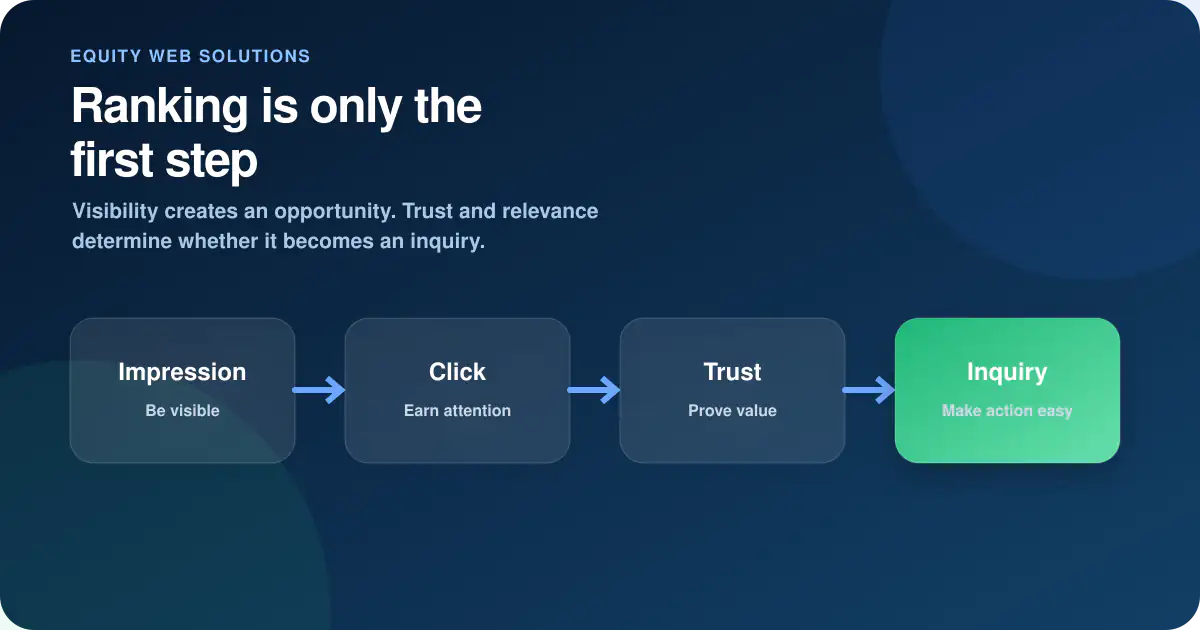
Ranking and being chosen are two different outcomes. A ranking can put a business in front of a potential customer. The page that receives the visit must still answer the buyer’s questions, establish credibility, and make the next step feel appropriate.
A website can rank well and still generate few leads when it attracts the wrong intent, communicates an unclear offer, lacks decision-stage proof, or creates conversion friction. Rankings create visibility; the landing page must still earn trust and action.
Why a ranking may not produce leads
| What search data shows | What the page must still accomplish |
|---|---|
| The page is visible for a query | Confirm the query represents a qualified buyer |
| The result earns a click | Explain the service and buyer fit immediately |
| Traffic reaches the website | Provide proof that addresses the buyer’s risk |
| The visitor reads the page | Offer a clear, proportionate next step |
Equity Ranking-to-Lead Diagnostic
Query fit → search result → page clarity → proof → action
A ranking produces leads only when the query attracts the right buyer, the search result earns the click, the page explains the offer clearly, the proof supports the decision, and the next step feels credible and easy.
A ranking is an invitation, not a conversion
Search performance is often discussed as if achieving a target position completes the job. In practice, the result still has to earn the click, and the landing page still has to earn consideration.
The buyer may compare several providers, return to search, ask an AI platform for alternatives, read reviews, visit an About page, or look for pricing guidance before making contact. The website must support that evaluation process rather than assuming the ranking itself creates trust.
Why visible pages fail to produce qualified inquiries
The page attracts the wrong intent
A page can rank for a popular phrase that does not represent a buyer who is ready or appropriate for the service. Traffic can increase while sales opportunity remains unchanged. This is why query relevance and lead quality matter more than raw visit totals.
The offer is difficult to understand
Visitors should be able to identify the service, intended customer, location, expected outcome, and next step quickly. Vague language forces the buyer to work too hard to determine whether the company is relevant.
The proof does not match the claim
A testimonial can support general trust, but a buyer evaluating a complex service may need a case study, methodology, example, credential, or explanation of the process. Proof is strongest when it addresses the specific risk the buyer is considering.
The page creates unnecessary friction
Slow pages, oversized forms, unclear buttons, hidden contact information, and generic calls to action can all interrupt a high-intent visit. The next step should match the level of commitment the buyer is ready to make.
The five questions a decision page should answer
- Is this the service I need? Explain the service in concrete terms.
- Is this designed for a business like mine? State the audience, situation, or fit.
- Why should I believe the company can do it? Present relevant evidence.
- What will the engagement involve? Explain the process, scope, and expectations.
- What should I do next? Provide a clear, proportionate action.
Measure the full path, not only the ranking
Google Search Console can show which searches produced impressions and clicks. Google Analytics can show the landing page where a session began and whether visitors completed defined key events. CRM or sales records are then needed to determine whether those events became qualified opportunities and revenue.
A useful measurement path is:
Query → search result → landing page → meaningful action → qualified lead → customer outcome.
If the chain breaks, the solution depends on where it breaks. Low click-through rate may point to the search result. Strong traffic with weak engagement may point to page relevance. Form submissions with poor lead quality may point to targeting, offer clarity, or qualification.
SEO and conversion strategy should share the same page
The best SEO page is not written for an algorithm and then handed to a separate conversion team. It is designed around the same buyer intent from the beginning. Search structure helps the page become discoverable; useful explanations and proof help the page become persuasive.
This is why our Strategic SEO and web design work evaluates visibility and the buyer path together. Ranking is valuable. Being chosen by the right customer is the business outcome.