
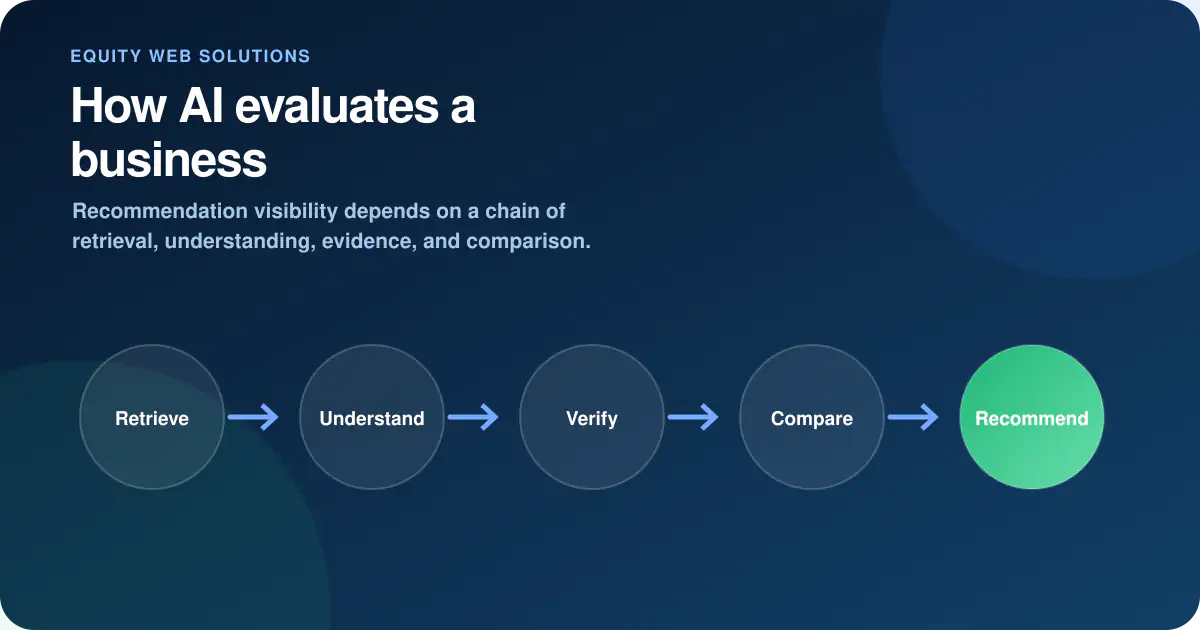
There is no single published formula that determines which business ChatGPT, Google AI, Perplexity, Claude, Gemini, Copilot, Grok, or Meta AI will recommend. The systems differ, results can change by prompt and location, and important parts of their ranking and generation processes are proprietary.
A business is more likely to be considered when its information is crawlable, clearly structured, relevant to the question, consistent across credible sources, supported by evidence, and easy to compare with available alternatives. None of these signals guarantees a recommendation.
The six signal groups behind AI business recommendations
| Signal group | What it helps establish |
|---|---|
| Access | Whether current information can be retrieved |
| Entity clarity | What the business is, offers, and serves |
| Relevance | Whether the business fits the specific prompt |
| Corroboration | Whether credible sources support key claims |
| Evidence | Whether expertise and outcomes are demonstrated |
| Comparability | Whether the business can be evaluated against alternatives |
Equity AI Evaluation Model
Retrieve → understand → verify → compare → recommend
AI visibility becomes easier to diagnose when the process is separated into five questions: can the platform retrieve the information, understand the business, verify its claims, compare it with alternatives, and justify including it in an answer?
Recommendation usually begins with retrieval
Before an AI system can use current website information, that information generally needs to be available to the system through a search index, an approved crawler, a licensed source, or another retrieval process. Google explains that its generative search features use its core Search systems to retrieve relevant, current pages and may issue several related searches to address different parts of a question.
OpenAI separately documents search and user-initiated crawlers, including OAI-SearchBot and ChatGPT-User. This does not mean allowing a crawler guarantees inclusion. It means blocking relevant discovery systems can prevent them from accessing information they might otherwise consider.
That distinction is important when using diagnostic tools. An AI visibility checker can test observable access, citations, mentions, and competitive presence, but it cannot expose a platform’s private recommendation formula.
AI systems need to understand what the business actually is
A website should make basic entity information unambiguous:
- The company’s official name and location
- The services it provides and the customers it serves
- The geographic areas it serves
- The people responsible for the business
- How someone can contact, evaluate, or hire the company
This information should be stated in visible language, not hidden only inside structured data. Organization and service schema can reinforce clearly presented information, but markup cannot compensate for vague or unsupported content.
Relevance is specific to the question
“Who is the best marketing agency?” is a different request from “Which San Diego agency specializes in technical SEO migrations for established service companies?” The second question contains location, service, situation, and customer-fit criteria. A company that explains those details clearly gives retrieval systems more useful material to evaluate.
This is why broad claims such as “full-service solutions for every business” are usually weak. Specific service pages, industries served, engagement criteria, case studies, methodology, and location information help define when the business may be a relevant answer.
Trust requires evidence, not repeated adjectives
Calling a business “trusted,” “leading,” or “award-winning” does not prove the claim. Stronger evidence can include:
- Named leadership and verifiable professional background
- Detailed case studies with measurement periods and limitations
- Clear methodology and explanations of how work is performed
- Accurate contact, service, and location information
- Original analysis that demonstrates first-hand experience
- Consistent information on credible third-party sources
Google’s people-first content guidance emphasizes original information, complete explanations, clear sourcing, authorship, and demonstrable expertise. Those are useful standards for any resource intended to inform people or be cited by an AI-generated answer.
Comparison requires enough information to distinguish one provider from another
An AI system cannot responsibly infer an agency’s pricing model, ideal client, engagement process, or specialty if the website never states them. Businesses often omit these details because they want every visitor to contact them. The result can be a site that sounds polished but provides little basis for comparison.
Useful comparison information includes:
- Who the service is and is not designed for
- Typical starting points, scope, and timeline
- How the company approaches the work
- What evidence is available
- What makes the engagement meaningfully different
What does not guarantee AI recommendations
No legitimate provider can guarantee that a particular AI platform will recommend a company. Schema alone is not enough. An llms.txt file is not a universal ranking mechanism. Repeating keywords, mass-producing generic articles, or manufacturing mentions does not create genuine authority.
Google’s current generative search guidance specifically says foundational SEO, crawlable pages, and unique, valuable content remain important, while special AI markup and content rewritten only for AI are unnecessary for Google’s AI search features.
A practical AI visibility framework
We evaluate AI visibility as a connected set of questions:
- Access: Can relevant systems reach and index the information?
- Clarity: Is the business, service, location, and audience explicit?
- Relevance: Does the site answer the specific questions buyers ask?
- Corroboration: Is important information supported consistently elsewhere?
- Evidence: Are claims supported by cases, methodology, expertise, or original data?
- Comparability: Can a buyer or system understand when this business is the appropriate choice?
This framework informs our AI visibility services and free AI Visibility Scan. It is a diagnostic model, not a promise that any platform will produce a specific answer.