
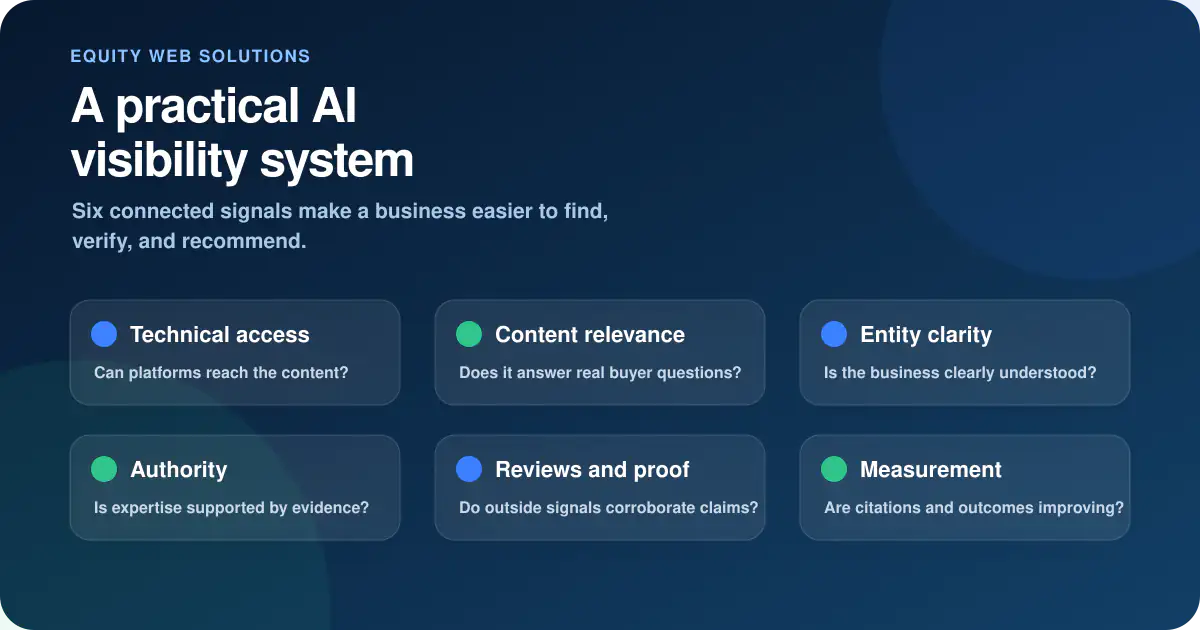
The best AI visibility solutions for businesses are not limited to one tool or technical file. They combine technical access, clear entity and service information, useful content, structured data, credible third-party proof, and measurement. The right starting point depends on why AI and search platforms are currently overlooking, misunderstanding, or failing to verify the business.
The six strongest AI visibility solutions are technical SEO, clearer entity and service information, content that answers buyer questions, appropriate structured data, credible reviews and citations, and repeatable measurement. Most businesses should begin with the specific constraint preventing platforms from retrieving, understanding, or verifying them.
What are the best solutions for AI visibility?
| Solution type | Best used for | Primary limitation |
|---|---|---|
| Technical SEO | Access, indexing, rendering, and internal discovery | Does not establish authority alone |
| Content improvement | Relevance, clarity, and buyer questions | Requires strong page strategy |
| Structured data | Machine-readable context | Cannot create credibility |
| Reviews and citations | Independent corroboration | Quality and consistency matter more than volume |
| Monitoring software | Tracking mentions, citations, and prompts | Does not correct the underlying gap |
| Professional service | Coordinated diagnosis and implementation | Quality depends on methodology and evidence |
Which AI visibility solution should a business prioritize first?
Prioritize the solution that addresses the earliest failure in the visibility chain. If important pages cannot be crawled or indexed, begin with technical SEO. If platforms cannot clearly identify the company, services, location, or audience, improve entity and service clarity. If the business is understood but rarely selected, strengthen useful content, proof, reviews, citations, and comparison information.
Monitoring software becomes most useful after the underlying pages and evidence are strong enough to evaluate. A dashboard can identify patterns, but it cannot correct unclear positioning, weak service pages, inconsistent business information, or unsupported claims.
What helps improve E-E-A-T for AI search visibility?
No single tactic creates E-E-A-T or guarantees AI visibility. The strongest improvements come from demonstrating first-hand experience, identifying qualified authors or leadership, supporting claims with specific evidence, citing reliable primary sources, publishing complete and accurate explanations, and maintaining consistent business information across credible third-party sources.
For service businesses, practical evidence may include named leadership, detailed service methodology, case studies with measurement context, authentic reviews, professional profiles, accurate citations, and clear explanations of who the service is designed for. Structured data can clarify these relationships, but it cannot replace visible evidence.
Equity AI Visibility Foundation
Access → clarity → relevance → proof → measurement
The strongest AI visibility solution is a connected foundation: make the information retrievable, describe the business explicitly, answer relevant buyer questions, support claims with credible proof, and measure which constraint deserves attention next.
Solution comparison
Match the solution to the constraint
| Solution type | Best used when | Does not solve by itself |
|---|---|---|
| Technical audit | Priority information cannot be crawled or indexed reliably | Weak proof or authority |
| Content improvement | The business is vague or missing buyer questions | Third-party corroboration |
| Authority development | Claims lack external support | Poor website clarity |
| Monitoring | You need repeatable measurement | Implementation |
Start by identifying the actual visibility problem
“AI visibility” can describe several different problems. A platform may be unable to retrieve the website, may misunderstand what the business does, may lack evidence for an important claim, or may have stronger evidence for a competitor. Those problems require different solutions.
A useful assessment should separate at least five questions:
- Can relevant crawlers and search systems access the information?
- Is the business, service, audience, and location stated clearly?
- Does the website answer the questions buyers actually ask?
- Can important claims be corroborated through credible sources?
- Can the business be meaningfully compared with alternatives?
Our free AI visibility checker is designed to provide an initial view of those signal categories. It is a diagnostic starting point, not proof that any platform will produce a particular answer. For a deeper explanation, see what an AI visibility checker measures—and what it cannot prove.
1. Technical access and indexability
Current information cannot influence a retrieved answer if the relevant system cannot reach it. Google explains that its search systems crawl, render, and index web content, while OpenAI documents separate crawler controls for search discovery, user-requested page visits, and model training.
The practical solution is foundational technical SEO:
- Return meaningful HTTP status codes.
- Keep important pages available through crawlable HTML links.
- Use canonical URLs consistently.
- Include indexable pages in a valid XML sitemap.
- Avoid blocking essential page resources.
- Document intentional crawler permissions in robots.txt.
An llms.txt file may be useful as an experimental publisher aid, but it is not a substitute for crawlability, indexing, and clear site architecture.
2. Clear entity, service, and location information
AI systems should not have to infer the basics. The website should consistently state the company name, service categories, intended customers, geographic coverage, contact information, and the people responsible for the work.
This information should agree across the website, business profiles, directories, professional associations, review platforms, and other authoritative references. Consistency does not mean repeating identical marketing copy everywhere. It means avoiding contradictions about who the business is and what it offers.
This clarity is part of our broader website authority work because entity understanding and buyer trust usually depend on the same evidence.
3. Content that answers real evaluation questions
Publishing more articles is not automatically an AI visibility solution. The higher priority may be improving a service page that never clearly explains the audience, process, proof, location, limitations, or next step.
Useful content should address the questions a buyer uses to evaluate alternatives:
- What exactly does the company provide?
- Who is the service designed for?
- What situations or problems does it address?
- What evidence supports the company’s claims?
- How is the approach different from available alternatives?
- What should a qualified buyer do next?
Google’s people-first content guidance emphasizes original information, complete explanations, clear sourcing, authorship, and demonstrable experience. Those are sound standards for content intended to help a person or support an AI-generated answer.
4. Appropriate structured data
Structured data can help machines interpret information already visible on a page. Depending on the page, useful types may include Organization, LocalBusiness, Service, Person, Article, BreadcrumbList, FAQPage, or WebApplication.
The markup should match the page, remain consistent with visible content, and use stable identifiers to connect related entities. Schema should not contain invented reviews, unsupported awards, fake ratings, or claims the visitor cannot verify.
Structured data improves clarity. It does not independently create authority or guarantee inclusion in Google or AI-generated results.
5. Reviews, citations, and credible third-party proof
A business can describe itself clearly while still providing limited external evidence. Reviews, accurate local citations, professional profiles, association listings, earned media, case studies, and relevant mentions can help corroborate identity, experience, location, and reputation.
The best solution is not manufacturing mentions or distributing the same generic paragraph across hundreds of sites. Prioritize sources that are legitimate for the business, visible to customers, maintained over time, and relevant to the claims being supported.
6. Measurement across search, pages, and AI responses
No dashboard can reveal one universal AI ranking. Platforms use different sources and systems, and answers can change with the prompt, user, location, and time. Measurement should therefore combine several forms of evidence:
- Google Search Console queries and landing-page visibility
- Indexing and crawl diagnostics
- Referral traffic from identifiable AI platforms
- A documented set of representative prompts
- Page-level changes and the results observed afterward
- Qualified inquiries and sales outcomes
Repeated testing can reveal patterns, but individual prompts should not be treated as a permanent ranking report.
7. A prioritized implementation plan
The final solution is deciding what to fix first. A technical access problem may deserve immediate attention. A business with sound access but weak service explanations may need content and page architecture. A well-structured site with little corroboration may need reviews, citations, case evidence, and authority development.
A sensible sequence is:
- Repair access, indexing, canonical, and sitemap problems.
- Clarify the business entity, services, audience, and locations.
- Strengthen the pages closest to buyer decisions.
- Add accurate structured data.
- Develop credible proof and consistent third-party references.
- Measure changes and reassess the next constraint.
How to choose the right AI visibility solution
Before buying a tool or service, ask what evidence it evaluates, which claims it can verify, what it cannot measure, and whether its recommendations connect to specific pages and business outcomes. Avoid providers that guarantee recommendations, present estimates as direct platform data, or sell one technical file as a complete solution.
Equity Web Solutions approaches AI visibility optimization as connected work across technical access, entity clarity, useful content, website authority, and measurement. You can also read how AI platforms may evaluate businesses before deciding which solution fits your current gap.
Related guidance: Compare the process in our AI visibility methodology, review the visibility benchmarks, or explore the full AI visibility service.
Plan the next step: Review what an AI visibility audit should evaluate before choosing fixes or commissioning a deeper assessment.