
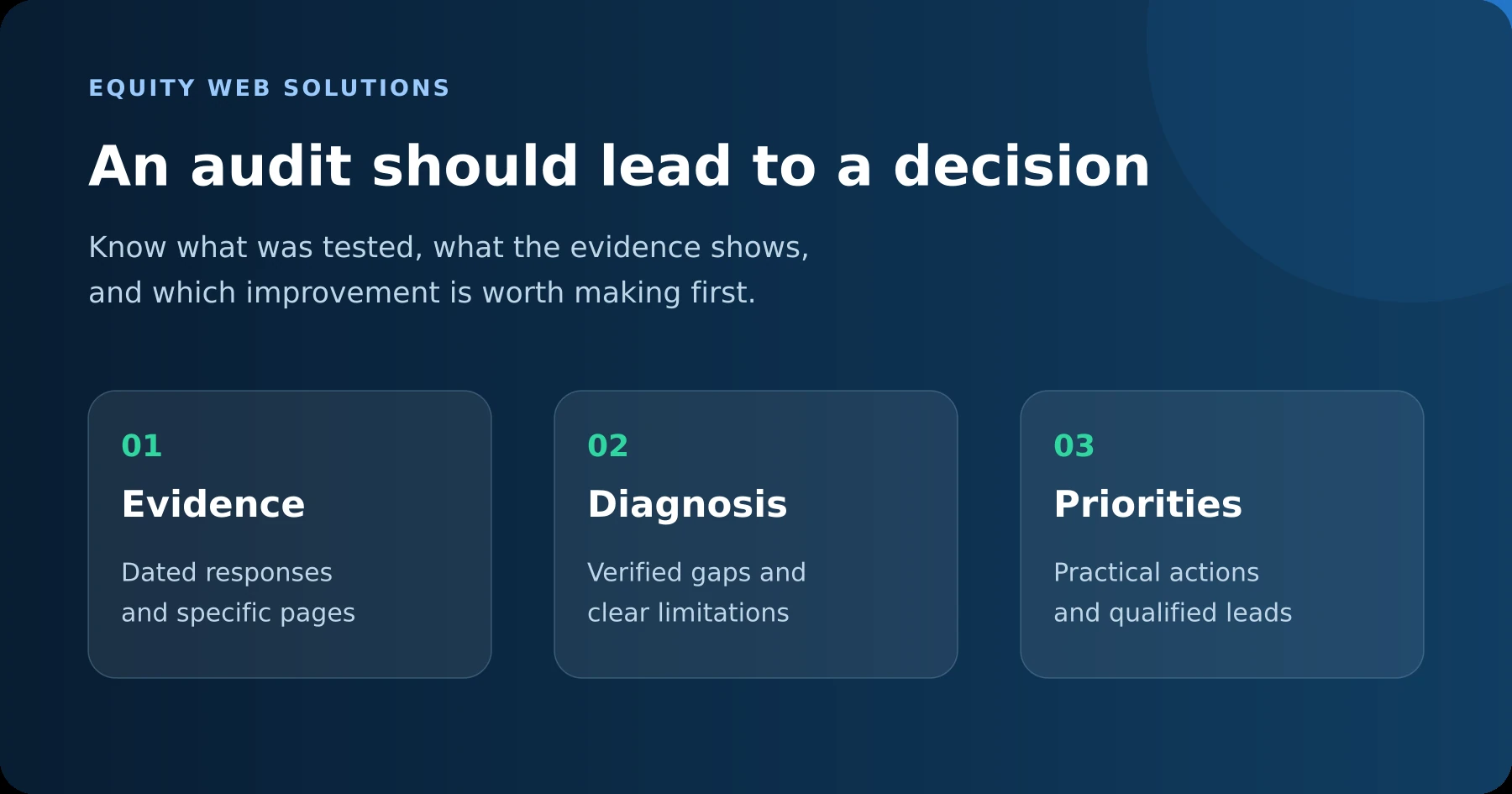
An AI visibility audit should establish where your business appears for relevant buyer questions, verify the evidence behind those results, and identify the changes worth making first. It should evaluate access, business identity, service pages, supporting proof, competitor visibility and lead measurement, with a clear record of what was actually tested.
For a San Diego business owner, the useful question is whether someone looking for your service can discover accurate information about your business and take the next step. A broad AI score can help start that conversation. A useful audit explains the specific gap, the evidence behind it and what to do about it.
This guide explains what to request before paying for an audit and how to judge whether its recommendations support qualified business inquiries.
What should you receive from an AI visibility audit
Ask for a defined scope before work begins. Which services, locations, pages and platforms will be reviewed? Will the provider directly test AI responses, inspect your website, evaluate outside sources or combine these approaches? These are different deliverables.
A useful final report should include the following:
- A buyer-focused question set tied to the services and areas you actually serve.
- Dated evidence showing mentions, recommendations, citations and absences in the tested responses.
- Page-level findings with specific URLs and reproducible technical checks.
- A comparison with relevant competitors answering the same buyer questions.
- A short action list with the reason for each change, an owner and a retest date.
If a report says your authority is weak, ask which evidence is missing. If it says your content needs optimization, ask which page fails to answer which buyer question. Recommendations should be specific enough to review and implement.
Evidence to request before accepting the report
| Audit area | Evidence to request | Decision supported |
|---|---|---|
| Access and eligibility | Affected URLs and reproducible checks | Which verified blockers to fix first |
| Buyer questions | Exact prompts, dated responses and cited sources | Where relevant discovery is missing |
| Service clarity and proof | Specific page gaps and corroborating sources | Which page or evidence to strengthen |
| Business outcomes | Referral evidence, event definitions and lead dispositions | Whether visibility supports qualified inquiries |
1 Check access and search eligibility
Start with the pages closest to revenue. Can search systems retrieve your service pages? Are those pages indexed where expected? Do redirects, canonical tags, noindex directives, security rules or rendering problems prevent access to important information? An audit should identify the affected URL and the check used to establish the problem.
For Google’s generative AI search features, its current guidance calls for pages to be indexed, eligible for a search snippet and included in those features through Search Console. Google does not require special AI schema or an llms.txt file for this purpose. See Google’s AI optimization guidance.
Access also needs a platform-specific review. OpenAI distinguishes OAI-SearchBot, used for ChatGPT search, from GPTBot, used for potential model training. Blocking training access is a separate choice from allowing search discovery. See OpenAI’s crawler documentation.
Request evidence of an actual access problem before changing crawler rules. A page being accessible does not prove that a platform will cite or recommend it.
2 Verify business identity and service clarity
A visitor should be able to establish who you are, what you do, who you help and where you operate. Review this information across the website, business profiles and relevant outside listings.
For a local business, an audit should check the business name, contact details, service area, principal services and current operating information. It should also check whether important profiles point to the correct website and whether outdated information creates conflicting descriptions.
Review the About page and identifiable people behind the business. Relevant qualifications, author information, genuine experience and a clear connection between the company and its founder can help a buyer verify claims. Do not add credentials, locations or affiliations you cannot substantiate.
The deliverable should name the inconsistency and show where it appears. A generic instruction to add more entity signals is too vague to act on.
3 Evaluate the pages that support buying decisions
Review whether your main service pages answer the questions a prospect needs resolved before contacting you: what is included, who the service fits, how the process works, what affects cost and what evidence supports your claims.
Keep each page’s role clear. A service page explains the offer and the next step. Supporting articles answer narrower questions and link to the relevant service. An audit should identify missing information and internal links without turning every article into a competing service page.
Ask the reviewer to connect each proposed addition to a real buyer question. Examples include a clearer description of deliverables, a relevant case study, an explanation of service boundaries or a stronger path to an inquiry.
Our AI visibility services cover the broader work of diagnosing visibility gaps, improving supporting evidence and reviewing progress.
4 Review proof beyond your own claims
An audit should evaluate whether a prospect can corroborate what your website says. Useful evidence may include detailed reviews, relevant business listings, industry references, independently published mentions and case studies with a clear scope and outcome.
Judge relevance and credibility, rather than counting every mention equally. A review describing the service a buyer needs may be more useful to that buyer than a large collection of vague testimonials. A case study should explain the problem, the work performed and the result, while protecting client information.
Separate missing proof from outdated proof. The right action might be correcting a profile, documenting a completed project or asking a real client for an honest review. It does not have to be publishing more blog posts.
Our website authority page explains how business credibility and supporting evidence fit into this work. No audit can establish an AI platform’s private weighting of those signals.
5 Test questions that real buyers might ask
A branded question such as “What does this company do?” checks whether a system understands your business. A service-and-location question checks a different situation: whether the business appears when the buyer has not already chosen a provider. Test both and report them separately.
Build question groups around actual services, locations and selection criteria. Include discovery questions, provider comparisons and practical evaluation questions. Avoid filling the test set with broad prompts that have little connection to a sale.
For every test, retain the exact question, platform, date, search mode, relevant location context, response and cited URLs. Record whether your business was merely mentioned, recommended as a provider or linked as a source. These outcomes should not be combined into one success count.
Repeat important questions under reasonably consistent conditions. Answers can vary, so a single screenshot is an observation rather than a dependable ranking. If an audit reports a visibility rate, it should define the question set, number of tests and calculation.
Our guide to how to measure AI visibility explains how to turn that baseline into ongoing monitoring.
6 Compare relevant competitors using the same evidence
Choose competitors a qualified buyer would reasonably consider for the same service and area. Compare their responses to the same question set and inspect the pages or outside sources actually cited.
Look for specific differences you can verify: clearer service descriptions, stronger project evidence, more consistent business details or outside sources covering the relevant service. These observations can guide further investigation.
Do not present correlation as a confirmed cause. A competitor appearing alongside a strong review profile does not prove that reviews caused its selection. A responsible audit separates what was observed from the proposed explanation and the action being tested.
7 Connect visibility to qualified inquiries
A mention or citation is a useful discovery signal. The business outcome is whether suitable prospects contact you and become customers.
Review identifiable AI referral traffic, landing pages and completed inquiry events alongside the lead log. Some discovery will not produce a directly attributable click, so keep attribution limits visible. Google’s current guidance points to its Generative AI performance report in Search Console for measuring inclusion in its AI features; inspect the reports available for your property.
Use precise event definitions. A completed form submission is not automatically qualified. A click to a booking calendar is not a completed appointment, and a phone click is not a confirmed call. Qualification requires enough information to establish service fit, location and legitimacy.
An audit should identify missing measurement and explain how future results will be assessed. If there is no lead log or booking confirmation data, say so instead of reporting every event as a customer opportunity.
How should audit findings be prioritized
The report should help you decide what to fix now and what to revisit later. Use this sequence to evaluate its action plan:
- Resolve verified access problems affecting priority pages.
- Correct inaccurate business information and unclear service descriptions.
- Strengthen relevant proof and the pages closest to a buying decision.
- Improve paths from supporting articles to the correct service and inquiry action.
- Retest the original questions and review qualified inquiries after changes.
For each action, request the affected page or source, observed evidence, expected benefit, effort, owner and review date. An expected benefit is a hypothesis to test, not a promised recommendation.
An example of a useful audit finding
Illustrative example: A San Diego commercial cleaning company appears when asked about its brand, but is absent from several tested questions about office cleaning providers. Its main page lists cleaning services without explaining office types, service boundaries or the scheduling process.
A useful report would preserve the dated test responses, identify those page gaps and recommend clarifying that existing service page. It might also recommend documenting a real office-cleaning project and correcting inconsistent service descriptions on relevant profiles. The next review would repeat the same questions and check actual inquiries.
That is an actionable diagnostic. It does not require inventing a new business location, creating several competing service pages or promising a position inside an AI response.
Questions to ask before choosing an audit provider
- Will you show the exact questions and dated responses behind your conclusions?
- Which checks are direct tests and which findings are inferred from public evidence?
- Will the report identify specific pages and sources to improve?
- How will you distinguish business mentions, citations and provider recommendations?
- How will you measure progress against qualified inquiries?
- What work is included in the audit, and what would be a separate implementation service?
Treat guaranteed AI placement and unexplained proprietary scores cautiously. You should be able to inspect the evidence and understand the proposed work even if a provider uses its own diagnostic framework.
Frequently asked questions
Is an AI visibility audit the same as a free scan
The scope determines the answer. Equity Web Solutions’ free scan provides an initial estimate from public evidence. A deeper audit should validate findings through a defined review and direct testing where included. Read what an AI visibility checker measures and our AI visibility methodology before interpreting a scan result.
Can an audit guarantee that ChatGPT or Google will recommend my business
No. An audit can document observable results, identify problems and recommend improvements. It cannot guarantee future responses or reveal every factor involved in selecting a source or business.
Should the audit focus only on AI platforms
It should evaluate the underlying website, business information and supporting evidence as well as direct visibility tests. Those findings should fit your existing SEO and lead-generation priorities.
How often should you repeat an audit
Establish a baseline, retest after meaningful changes and use a consistent review schedule for the questions that matter most. Agree on the schedule in advance. Avoid major rewrites based on one changed response.
Start with the evidence your business already has
An effective AI visibility audit connects a buyer question to an observed result, a specific gap and a practical next action. That gives you a basis for deciding where to invest and how to judge progress.
Run the Free AI Visibility Scan to get an initial public-evidence estimate. If you need a deeper assessment of your services, competitors and next steps, explore our AI visibility services.