
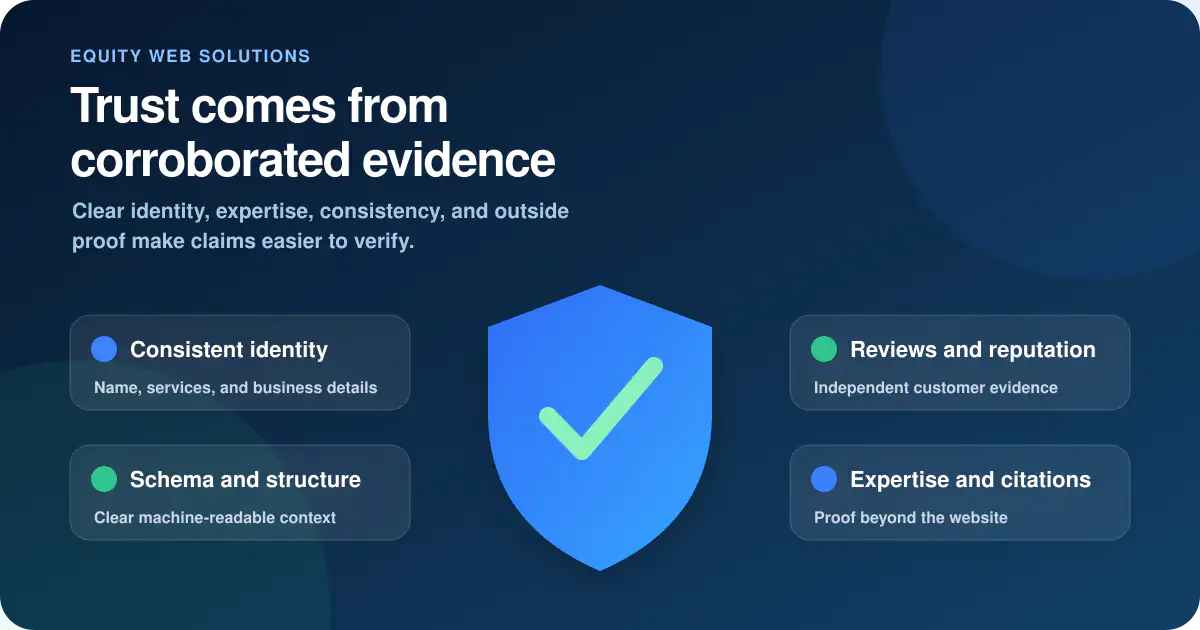
Search and AI systems do not evaluate trust exactly as a person does, and no public checklist guarantees that a business will rank or be recommended. However, a business can make its identity, expertise, services, and evidence substantially easier to understand and verify.
Trust grows when a website clearly identifies the business and its people, explains services in depth, supports claims with evidence, cites reliable sources, maintains consistent information, and uses structured data that accurately reflects visible content.
Business trust signals and what they actually support
| Signal | What it helps establish | What it does not prove alone |
|---|---|---|
| Clear business identity | Who operates the company and where | Service quality |
| Reviews and citations | Independent corroboration and consistency | Universal customer satisfaction |
| Case studies and methodology | Experience and process | Guaranteed future outcomes |
| Structured data | Machine-readable context | Authority or recommendation eligibility |
Equity Evidence-Clarity-Corroboration Model
Clear claims become stronger when they are supported and consistently verified
Trust is not one score. It develops when the website states the facts clearly, visible evidence supports the claims, and credible third-party sources corroborate the same business identity, services, expertise, and reputation.
Begin with a clear business identity
A visitor or system should not have to infer who operates the website. Core information should include:
- The official business name
- Primary location and service areas
- Contact information
- Named founder or leadership
- Services and intended customers
- Relevant business history and expertise
Google’s Organization structured-data guidance explains that organization markup can help Google understand administrative and identity details. The markup should reinforce the information visitors can see; it should not introduce unsupported claims.
Demonstrate expertise through the content itself
Expertise is more persuasive when it is visible in the work. Original analysis, detailed explanations, documented processes, and honest discussion of limitations provide more evidence than repeating credentials or promotional adjectives.
Google’s people-first content guidance asks whether content demonstrates first-hand expertise, provides original information or analysis, identifies the author, uses clear sourcing, and gives the reader a complete answer. These are useful editorial standards even when a page is not written primarily for Google.
Support claims with proportionate evidence
Different claims require different forms of support:
- Performance claims: case studies with baseline, measurement period, metric definitions, and limitations
- Experience claims: named people, history, examples, and areas of responsibility
- Process claims: methodology that explains how decisions are made
- Service claims: specific scope, deliverables, and intended customer
- Research claims: transparent sample, methodology, date, and source data
Evidence does not need to reveal confidential client information. It does need to be specific enough that the reader can understand what the claim means.
Make important information consistent
A business becomes harder to verify when its name, address, services, leadership, or contact information conflict across pages and public profiles. Consistency does not mean duplicating identical paragraphs everywhere. It means the underlying facts agree.
On the website, review the header, footer, contact page, About page, service pages, structured data, privacy information, and any downloadable documents. Material changes should be updated across all relevant locations.
Use structured data as clarification, not decoration
Organization, Person, Service, Article, Breadcrumb, and LocalBusiness markup can clarify the type and relationships of information already presented on a page. Structured data can support eligibility for certain search features, but Google states that markup must follow its guidelines and does not guarantee display.
Common problems include duplicate schema generated by several plugins, markup that contradicts visible content, unsupported ratings, invented awards, and properties added merely because they are available.
Show who created important content
Articles and original research should identify the author and connect to meaningful background information. A byline that leads to a substantive author or About page helps readers evaluate the perspective and expertise behind the work.
For Equity Web Solutions, that means connecting strategy articles to Paul Kahn, explaining the company’s experience, and distinguishing first-hand professional analysis from facts documented by platforms.
Remove signals that undermine confidence
Trust can be weakened by:
- Broken links and unfinished pages
- Unsupported superlatives and guarantees
- Generic content with no identifiable author or experience
- Conflicting business details
- Fake dates or articles republished as “new” without substantive changes
- Schema that does not match the page
- Case studies that omit material context
Website authority is a connected system
No single trust badge, schema block, article, or review creates authority. The strongest sites connect identity, services, leadership, proof, original expertise, technical accessibility, and accurate business information.
If you want to evaluate those signals systematically, start with what an AI visibility checker can actually measure and which findings still require human interpretation.
That connected approach is what we mean by Website Authority: make the business easier for people, search engines, and AI platforms to understand and verify without overstating what any one signal can accomplish.