
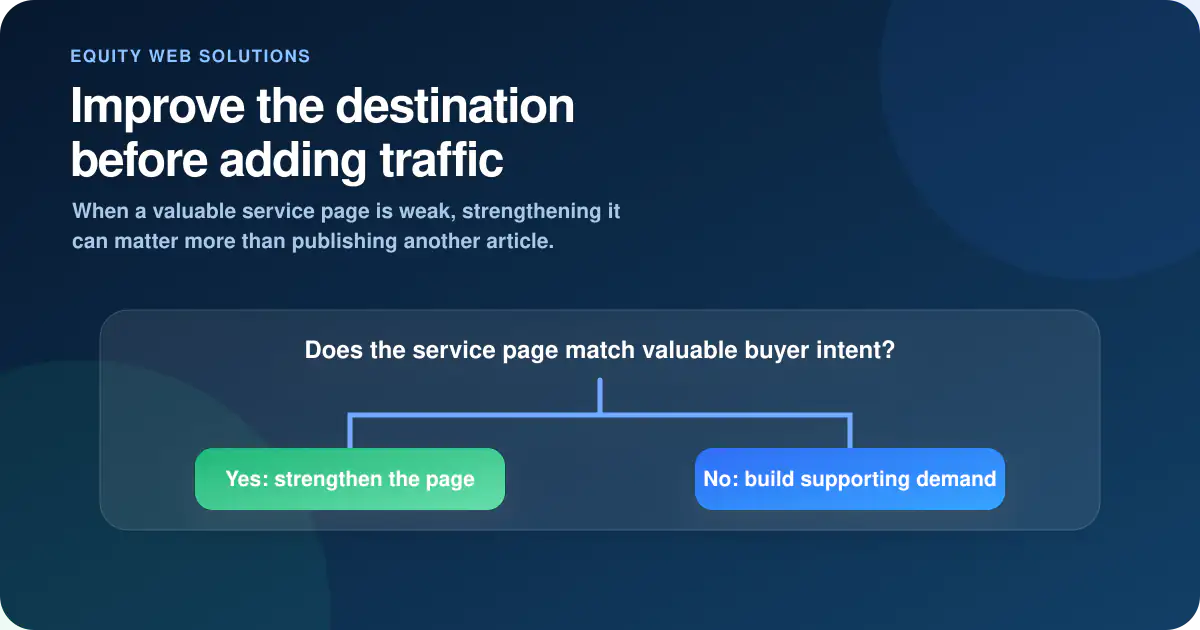
A blog can attract informational searches, demonstrate expertise, and answer early-stage questions. But for many service businesses, the page closest to revenue is the service page. If that page is thin, vague, or unconvincing, publishing more articles may expand traffic without fixing the primary decision point.
Blog articles support discovery and expertise. Service pages establish commercial relevance and help buyers decide. When resources are limited, strengthen the page responsible for the service before creating more loosely connected content.
Service pages and blog posts serve different search intents
| Service page | Blog article |
|---|---|
| Targets buyers evaluating a service | Targets questions and early-stage research |
| Explains fit, process, proof, and next step | Builds understanding and topical coverage |
| Usually closer to a lead or sale | Often assists discovery and internal linking |
| Prioritize when commercial pages are weak | Add when it fills a distinct information gap |
Equity Service-Page-First Test
Demand exists + commercial page is weak = improve the service page first
Publish another article only when the core service page already explains the audience, problem, process, proof, differentiation, location, and next step—and a distinct informational question still deserves its own page.
Service pages and articles perform different jobs
An article typically answers a question, explains a problem, or helps someone research a topic. A service page explains what the company provides, who it is for, why it matters, how the work is performed, and what the buyer should do next.
Both can be useful, but they should not be treated as interchangeable.
- Articles support education, topical depth, internal linking, and early-stage discovery.
- Service pages support commercial search intent, provider evaluation, qualification, and conversion.
Signs the service page should come first
The page could describe almost any company
Language such as “custom solutions,” “unmatched quality,” and “results-driven service” provides little information about what is actually delivered. A strong service page replaces general claims with specific scope, audience, process, proof, and outcomes.
Several distinct services share one short page
When every offering is compressed into a paragraph, search engines and buyers receive limited information about any one service. Separate pages may be warranted when the services address distinct needs, searches, or buying decisions.
The page receives impressions but few qualified inquiries
Search Console and Analytics can reveal a page that is visible but ineffective. Before expanding the content calendar, determine whether that decision page matches the right searches and supports the right action.
Articles have nowhere useful to link
Informational content should lead readers toward a relevant next resource. If the core service page is weak, internal links send visitors to an incomplete explanation and transfer limited contextual value.
What a complete service page should explain
The appropriate structure varies by service, but a useful page often addresses:
- The problem or situation the service addresses
- The people or organizations it is designed for
- The scope and major components of the work
- The company’s approach or methodology
- Relevant proof, examples, or case studies
- Location or service-area considerations
- Timeline, investment guidance, or engagement expectations
- Common questions and the appropriate next step
This is not a required word-count formula. Google explicitly says there is no preferred word count. The page should be as complete as necessary to help the intended buyer understand and evaluate the service.
When an article is the right next investment
Once the service foundation is clear, articles can address questions that do not fit naturally on the commercial page. Good candidates include:
- How to evaluate different approaches
- Common mistakes and tradeoffs
- Original research or benchmark findings
- Detailed explanations of a process
- Questions that regularly arise before a sales conversation
Each article should have a real purpose and a clear relationship to the company’s expertise. Google’s people-first guidance warns against producing large amounts of content across many topics simply to attract search traffic.
A practical order of operations
- Identify the services most important to the business.
- Map each service to the buyers and searches it should address.
- Make the service page complete, credible, and conversion-ready.
- Create supporting articles around genuine customer questions and original expertise.
- Connect articles and service pages with descriptive internal links.
- Measure visibility, engagement, and qualified outcomes by page.
This is the reasoning behind our web design and Website Authority work. More content is not automatically a stronger website. The priority is content that performs a necessary job in the buyer journey.