
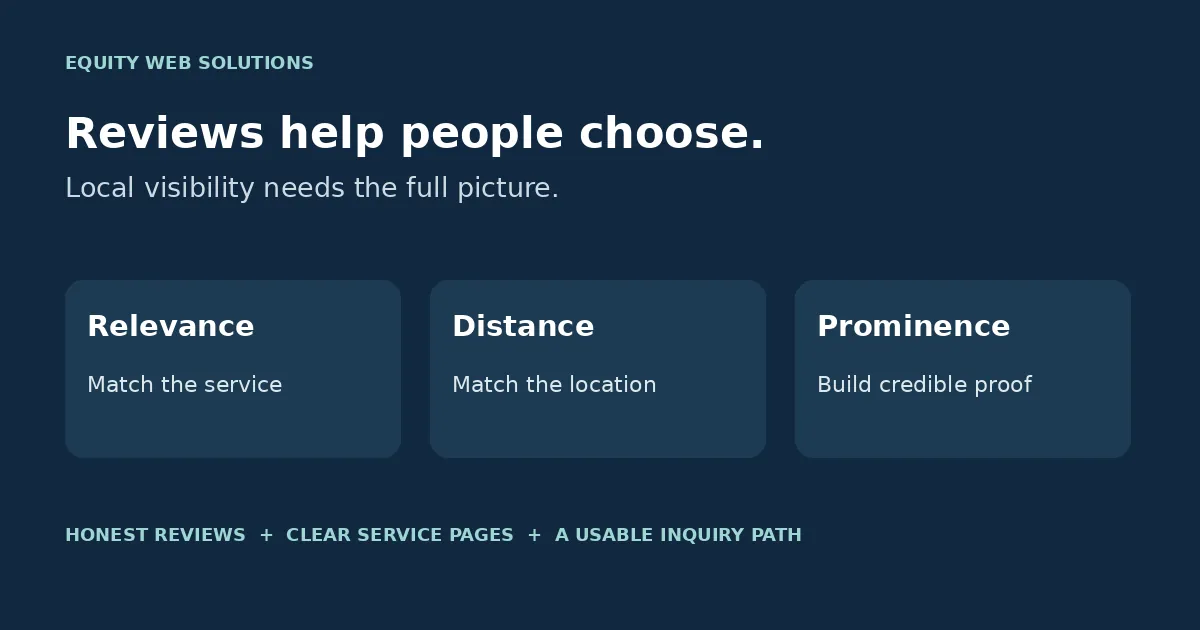
Google reviews can help your business compete in local search and help a customer decide whether to contact you. They are one part of the picture. More reviews will not overcome every relevance, distance, website, or customer-experience problem.
Reviews support local prominence and buyer confidence. Build a consistent process for requesting honest feedback from real customers, responding thoughtfully, and connecting that proof to clear service information. Judge the work by relevant visibility and qualified inquiries, not a review-count target alone.
Trying to turn Maps visibility into inquiries? Our San Diego Local SEO service connects Business Profile accuracy, service pages, legitimate reviews, and lead measurement.
How reviews fit into Google Maps rankings
Google describes local results in terms of relevance, distance, and prominence. Relevance is how well the business matches the search. Distance concerns where the business is relative to the searcher. Prominence concerns how well known the business is, including information Google finds about it online.
Google says more reviews and positive ratings can help local ranking. That does not mean a business with the most reviews always wins. A nearby specialist with a closely matched service may appear ahead of a larger company with a much higher review count. Results also vary with the query and the searcher’s location.
For a San Diego service business, compare competitors serving the same area and buyer need. A La Jolla practice, a North County contractor, and a citywide provider may face different local results. One search from your office cannot establish what every potential customer sees.
Three separate questions
Can they find you? Can they trust you? Can they contact you?
Reviews contribute to the first two questions. Accurate service information, relevant website pages, and a usable inquiry path still matter. A stronger profile should lead to a clearer buying decision.
What a useful review helps a buyer understand
A star rating is a quick signal. The written experience gives it context. A potential customer wants to know whether your business handles work like theirs, communicates reliably, and follows through. Specific, authentic experiences can be more helpful than a page of identical praise.
- Service fit: Does the feedback describe the kind of work the customer needs?
- Experience: What was communication, scheduling, or delivery like?
- Credibility: Does the collection sound like different real people describing their own experiences?
- Response: Does the business handle both praise and concerns professionally?
Encourage customers to use their own words. Do not supply a script packed with service and city keywords. If you offer several services, feedback about different completed projects can help buyers understand the breadth of the business without turning each review into advertising copy.
Recent feedback also helps a reader judge whether older experiences still reflect the business today. That is a practical trust consideration, not a claim that Google gives a fixed ranking bonus for receiving a certain number of reviews each month. Google does not publish a universal review-frequency target.
Build a review process your team can actually maintain
Start with a normal moment in the customer relationship, such as completion of a project or delivery of a service. Give the responsible team member a clear task and a direct Google review link. Apply the request consistently to eligible customers rather than inviting only people expected to give five stars.
| Step | What to do | What to avoid |
|---|---|---|
| Choose the moment | Ask after a real service experience, when the customer has something meaningful to describe. | Requests before work is delivered or pressure during a dispute. |
| Make it easy | Use a direct review link and a short, optional request. | Long instructions, repeated messages, or a required star rating. |
| Keep it honest | Invite genuine feedback consistently and let customers choose their wording. | Incentives, purchased reviews, or filtering out unhappy customers. |
| Respond and learn | Acknowledge useful feedback and route service problems to the right person. | Canned keyword paragraphs, arguments, or disclosure of private details. |
| Review results | Track requests, published feedback, relevant visibility, and qualified inquiries. | Reporting review growth as proof of new revenue. |
A straightforward request is enough: “Thank you for working with us. If you would like to share your experience, here is our Google review link. Honest feedback helps others decide whether we are a good fit.” Adapt the timing and channel to the relationship, and respect customers who prefer not to participate.
For sensitive services, privacy and professional obligations should shape whether and how you request feedback. Do not publicly confirm a person’s client status or disclose details simply because they posted a review.
Avoid tactics that create misleading proof
Google prohibits fake engagement, including reviews that are not based on a genuine experience and incentives offered for reviews. Do not buy reviews, ask employees to pose as customers, or offer discounts, gifts, or payment in exchange for feedback. A customer should also not need to change or remove criticism to receive a benefit.
Do not use a satisfaction survey to send happy customers to Google while routing dissatisfied customers exclusively to a private form. You can collect private feedback and resolve problems, but the public review invitation should not selectively solicit positive reviews.
AI can help organize a response workflow or suggest wording for a business reply. It should not invent customer experiences. The useful work is making genuine feedback easier to request and learn from, rather than manufacturing a more impressive profile.
What if a competitor has more reviews and you still need leads?
Review count is an easy difference to notice, so it can distract from the actual constraint. Before assuming you need hundreds of additional reviews, check whether the profile has the correct category and service information, whether the website explains the service clearly, and whether a mobile visitor can complete the next step.
Our Google Business Profile optimization guide covers that broader profile review. The San Diego local ranking guide connects it to the website and local search evidence.
Illustrative example, not a client result
The better next step may be on the website
A contractor has credible reviews and appears for relevant Maps searches, but the linked page gives no project scope, no useful examples, and no clear estimate process. More reviews may help trust, but clarifying the service and repairing the inquiry path addresses a different, visible problem. Investigate both before choosing the work.
Reviews should corroborate the promise your website makes. If customers repeatedly praise responsiveness, make the inquiry process easy to understand. If feedback reveals confusion about project scope, clarify that scope before spending more to send people to the page.
Measure reviews, visibility, and inquiries separately
Maintain three small records. First, track the review process: eligible requests, published reviews, rating distribution, recurring themes, and responses. Second, review visibility for the actual service and area. Third, record legitimate inquiries, their source where known, the requested service, qualification, and outcome.
Google Search Console reports website search performance; its average positions are not a geographic Maps-grid ranking report. A page-wide average also combines many searches. Review exact queries and the pages appearing for them before deciding which content needs attention.
A phone-button click is not a completed call. A booking-page click is not a confirmed appointment. A form submission still needs screening for duplicates, spam, service fit, and location. These distinctions prevent a busy report from becoming a misleading lead scorecard.
Compare consistent periods and record when review requests or website changes began. If reviews and inquiries rise together, that is a useful signal to investigate, not proof that reviews alone caused the increase. Read what a monthly SEO engagement should demonstrate for a practical standard of accountability.
Frequently asked questions
How many Google reviews do you need to rank?
There is no universal number. Competition, relevance, location, prominence, and the search itself affect results. Compare relevant competitors, then build a sustainable process for genuine feedback instead of chasing an arbitrary threshold.
Should you ask customers to mention the service and city?
Let customers describe their experience naturally. A light invitation to explain the work can be useful, but avoid prescribing keywords, locations, star ratings, or identical wording.
Does replying to every review guarantee better rankings?
No. Thoughtful replies demonstrate attention and help customers understand how you operate. They do not establish a guaranteed ranking increase, and repeating keywords in every reply is not a substitute for useful communication.
Can you remove a negative review?
You can report a review you believe violates Google’s policies. Disagreement with criticism alone does not establish a violation or guarantee removal. Respond professionally where appropriate and address legitimate service issues.
Want to understand what is holding back your local inquiries? Book a Visibility Review to assess your profile, priority pages, customer proof, and inquiry path together.