
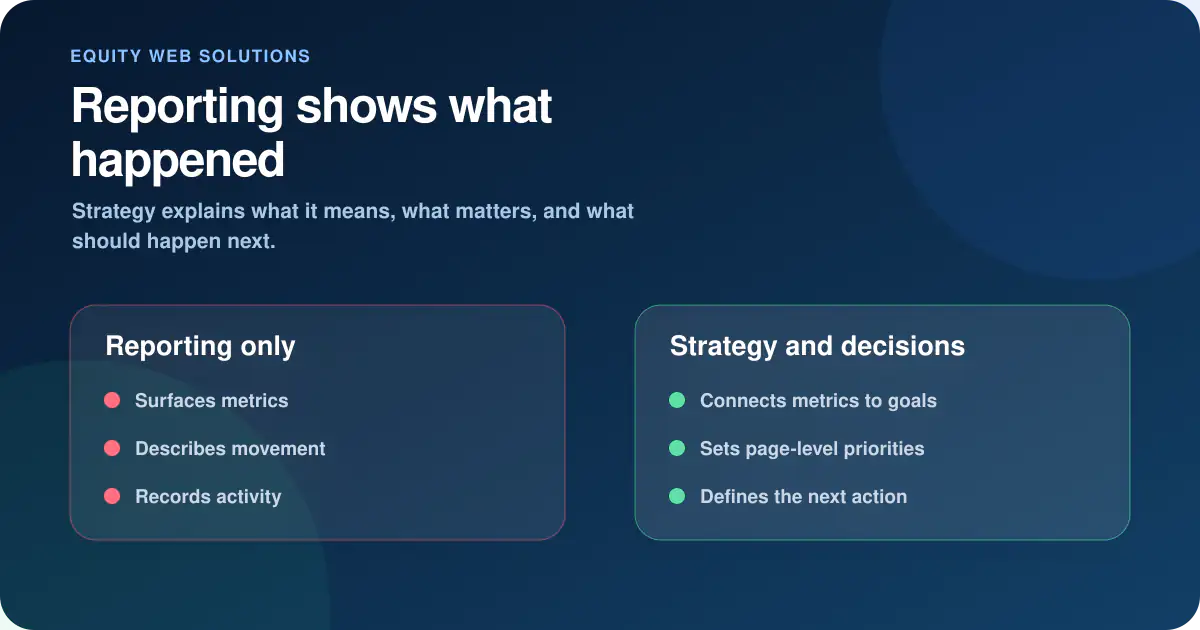
An SEO report can tell you that impressions increased, rankings changed, or organic traffic declined. Those facts matter, but they do not tell a business owner what should happen next. Reporting becomes useful only when it turns measurement into a decision about a page, an audience, and a business outcome.
SEO reporting is the evidence layer—not the strategy. A decision-ready review should explain what changed, why it matters, which page deserves attention, what should be improved, and how success will be measured.
SEO reporting and SEO strategy are not the same
| SEO reporting | SEO strategy |
|---|---|
| Describes clicks, impressions, rankings, and traffic | Explains which business opportunity deserves attention |
| Shows what changed | Interprets why the change matters |
| Summarizes multiple pages | Assigns responsibility to a specific page |
| Tracks activity and outcomes | Prioritizes the next action and measurement |
Equity Decision-Ready SEO Framework
Data → diagnosis → priority → action → business outcome
A useful SEO report should move through five stages: show what changed, explain why it matters, identify the page or query creating the opportunity, recommend the next action, and connect that action to qualified demand.
What an SEO report can tell you
Google Search Console reports clicks, impressions, average click-through rate, and average position. Those metrics can reveal where a site is appearing, which queries are creating exposure, and whether searchers are choosing a result. Google Analytics can then show which landing pages people entered through and whether those visits produced meaningful actions.
Together, those systems help answer important diagnostic questions:
- Which pages are gaining or losing search visibility?
- Which queries are creating impressions but few clicks?
- Which landing pages attract relevant visitors?
- Which pages contribute to calls, forms, bookings, or other key events?
That is valuable evidence. The limitation is that a dashboard rarely explains the business meaning behind the numbers.
Where reporting stops and strategy begins
Consider a service page that receives 12,000 impressions, ranks between positions eight and fifteen, and produces few inquiries. A report may label the page as “improving” because impressions increased. A strategy review asks harder questions:
- Are the queries commercially relevant or merely informational?
- Does the title clearly match what the right buyer is looking for?
- Does the page explain the service, location, process, proof, and next step?
- Is the offer appropriate for the searches producing visibility?
- Is tracking capturing qualified outcomes rather than every form submission?
The same data can support very different decisions. The correct action might be improving the title, expanding the service explanation, adding proof, changing internal links, clarifying geographic relevance, repairing conversion tracking, or deciding that the query is not valuable enough to pursue.
A useful SEO review should connect five layers
1. Search opportunity
Identify the queries and topics where real demand overlaps with the company’s services. High volume is not automatically high value. A smaller group of searches with clear commercial intent may be more important than a large informational audience.
2. The page responsible for the opportunity
Every recommendation should identify the page expected to earn visibility and convert the visitor. Without that connection, recommendations tend to become vague requests for “more content.”
3. The reason the page is underperforming
The constraint may be technical, editorial, competitive, geographic, reputational, or conversion-related. Different problems require different work. Publishing another article will not repair a service page that is unclear, unconvincing, or poorly matched to buyer intent.
4. The recommended change
A decision-ready report should specify what will be changed and why. “Improve on-page SEO” is not a meaningful recommendation. “Rewrite the title and opening section to match commercial searches for San Diego web redesign, then add migration proof and a clear consultation path” is actionable.
5. The business measurement
Success should be evaluated with the metric appropriate to the decision: qualified inquiries, booked calls, revenue, lead quality, click-through rate, or visibility for a defined group of searches. Rankings are useful, but they are usually an intermediate outcome.
What business owners should expect from SEO reporting
A strong report does not need to be long. It needs to be accountable. It should distinguish verified data from interpretation, document the measurement period, explain important limitations, and prioritize a manageable number of actions.
At Equity Web Solutions, this is the basis of Strategic SEO: use search and website data to decide which page, signal, or buyer-path problem deserves attention first. The objective is not to produce a more impressive dashboard. It is to make a better marketing decision.