Entity
Can AI systems clearly identify the business, category, people, locations, and relationships between them?
AI Visibility Services
Improve the clarity, proof, structure, and authority signals that help ChatGPT, Google AI, Perplexity, and other AI platforms understand and verify your business.
This is a diagnostic and implementation service. We identify the specific recommendation gaps affecting your business, prioritize the work, and strengthen the authority signals that support trust.
Comparing tools or approaches? Read our guide to AI visibility solutions.
Strategic principle
Recommendation signals
Different AI platforms use different retrieval systems, but they all need clear, consistent, and corroborated information before they can confidently identify, compare, or reference a business.
Can AI systems clearly identify the business, category, people, locations, and relationships between them?
Do service pages explain what the business does, who it helps, and when it is the right fit?
Are location, service-area, buyer-intent, and topical signals specific enough to establish relevance?
Do reviews, testimonials, schema, citations, case studies, and third-party mentions support credibility?
Is the business consistently corroborated across its website and the external sources AI systems can access?
Clear next steps tied to the signals most likely to improve understanding, verification, and qualified visibility.
What the service includes
The scan provides an initial estimate. The paid service validates the evidence, fixes the highest-value recommendation gaps, and tracks whether the business becomes easier to understand and verify.
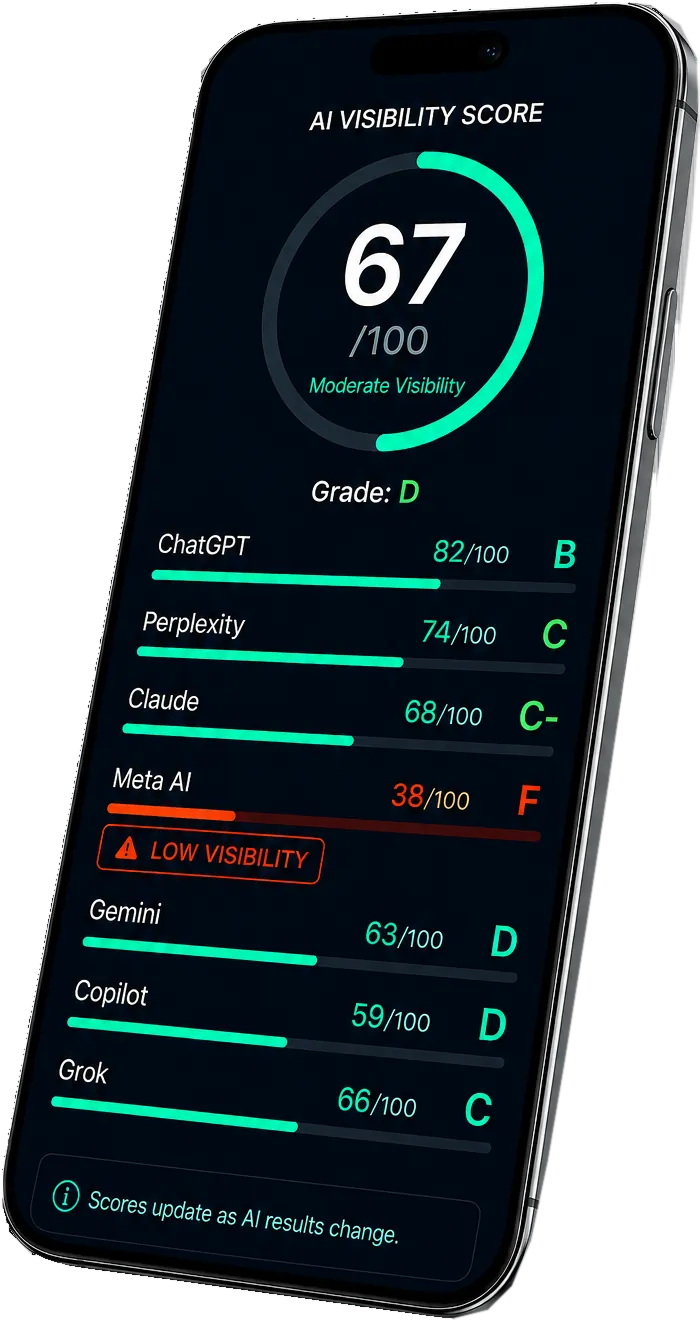
Diagnostic example
A business may appear visible in some AI environments while still having weak evidence in the categories that support confident recommendations.
This representative example shows the type of finding the service is designed to surface. It is an illustration of the diagnostic process, not a promise of a specific platform outcome.
See how the methodology worksMake the offer, audience, locations, and differentiators easier to identify.
Improve reviews, citations, case evidence, and third-party references.
Align schema, entity information, internal links, and supporting authority.
Platforms
Buyers are asking AI platforms for recommendations, comparisons, and next steps. The free scan estimates readiness from publicly visible evidence; direct prompt testing belongs in a deeper review.
How this connects to SEO
Clear service pages, strong proof, consistent entity information, useful content, and verifiable authority help both search engines and AI platforms understand and trust a business.
Start here
Get an initial estimate of how clearly your business appears across major AI environments and which recommendation signals may need attention.
The scan is designed to answer one practical question: where should you look first?
Run the Free AI Visibility ScanFree. No credit card required. Results are based on publicly visible evidence.
Overall readiness estimateSee how clearly your business appears to be understood and verified.
Platform-oriented breakdownReview estimated readiness across major AI environments.
Lowest signal categoriesIdentify the clarity, proof, structure, or authority gaps most worth examining.
Priority next stepsSee which areas may deserve a deeper review first.
AI visibility FAQs
Clear answers about what can be measured, what can be improved, and what no provider can responsibly guarantee.
Next step
Validate the evidence, prioritize the strongest opportunities, and decide what should be improved first.