
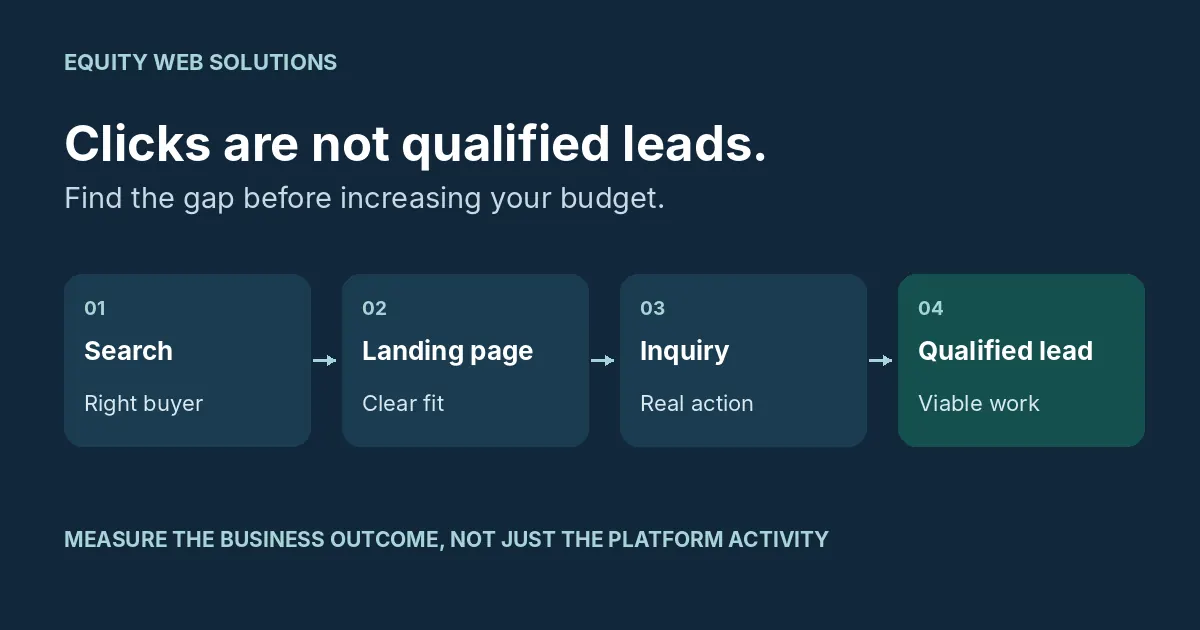
If Google Ads generates clicks but no qualified leads, the problem usually lies somewhere between the search that triggered the ad, the page the visitor reaches, the action being counted as a conversion and the way the business evaluates the inquiry. Increasing the budget before locating that problem can simply buy more of the wrong activity.
Review actual search terms, service-area fit, campaign structure, landing-page message match, conversion settings and real lead outcomes. Separate an inquiry from a qualified opportunity, then use the evidence to decide what to fix before spending more.
Already paying for clicks that do not turn into business? Our Google Ads management in San Diego connects targeting, landing pages and conversion tracking with the quality of the inquiries you actually receive.
First, identify where the campaign is losing value
A campaign with no inquiries is different from one generating plenty of inquiries that your team cannot use. Both can look like a lead-generation failure, but they require different diagnoses. Start by separating three situations.
| Symptom | Inspect first | Likely next step |
|---|---|---|
| Clicks, no inquiries | Search terms, destination page, mobile forms and tracking | Verify demand and remove friction |
| Inquiries, poor fit | Services requested, locations, quantities, budget and lead records | Refine targeting and qualification |
| Conversions, no real inquiries | Conversion actions, duplicates and actual call or form records | Correct the measurement signal |
The Equity lead-quality framework
Search intent → message match → inquiry → qualified opportunity
Each stage needs evidence. A click does not establish intent, a recorded conversion does not establish lead quality, and a qualified lead does not guarantee a sale. Find the first stage that breaks before changing the rest of the system.
1. Your ads are reaching the wrong searches or locations
Keywords are targeting instructions; search terms are what people actually searched for. A campaign targeting a profitable service can still attract price shoppers, job applicants, DIY research, customers looking for a different service or inquiries below a viable project size. Even a search that contains the right industry words may represent the wrong buyer.
In managing campaigns for service businesses, we look beyond whether a query sounds relevant. We ask whether the business would want to receive that inquiry. For example, a commercial electrical contractor and a residential electrician may both appear for an electrical repair search, but they serve materially different jobs. A company purchasing large quantities of industrial surplus may receive a genuine inquiry about a single small component that it cannot profitably handle.
Review available search terms alongside their matched keywords, cost, campaign and resulting lead disposition. Identify repeated mismatches and consider appropriate negative keywords, tighter matching or clearer ad groups. Avoid excluding an entire category because one visitor was a poor fit. Google’s search terms report is useful for this work, but it does not reveal every individual query.
Also check geographic fit. Google Ads can include people interested in a target area, not just those physically located there. For a business that serves customers on site, evaluate whether a presence-based setting better matches the service area. A remote buyer arranging work at a local property can still be valuable, so use actual lead evidence before narrowing coverage.
2. The ad promises something the landing page does not deliver
When someone clicks an ad for a specific service, the landing page should immediately confirm that service and explain who it is for. A generic homepage can force the visitor to reconstruct the promise they just clicked on. This is particularly expensive when a business advertises several distinct services.
Check the destination on a phone, using the actual ad URL. The page should make the service, geography, fit requirements and next step clear without requiring the visitor to search the navigation. Credible project examples, reviews and a straightforward inquiry path help the right buyer proceed. Test the real form submission and phone links, not just the appearance of the buttons.
Qualification can happen before the form. If you only serve commercial customers, handle projects above a certain scope or operate within defined locations, say so plainly. Relevant ads and clear landing-page language may reduce some clicks or form submissions while improving the proportion of inquiries your team can use. The objective is qualified demand, not maximum traffic.
For a deeper explanation of why visibility alone does not create business, see why high Google rankings do not always produce leads. The same trust and decision principles apply after a paid click.
3. Google Ads is optimizing toward the wrong conversion
Open the conversion actions report and determine exactly what is being counted. A contact-button click, form start, duplicate thank-you event or short call may have been configured as a successful action even though no real inquiry occurred. Test the complete customer path and compare the advertising record with your call log, inbox or CRM.
Google Ads distinguishes primary actions used for reporting and eligible bidding optimization from secondary observation actions. The campaign’s selected goals matter as well; secondary actions included in a custom goal can still influence bidding. Review the actual campaign goal configuration rather than assuming a label alone determines the outcome.
For businesses with longer sales cycles, a valid form or call may be a useful starting signal. Record whether each inquiry was qualified and whether it became booked work. Where enough reliable data is available and consent and data-handling requirements are met, import downstream qualified or converted lead outcomes using Google’s supported conversion tools. Sparse accounts may need to continue using a verified inquiry signal while collecting better downstream evidence. Do not abruptly switch the bidding objective to a rare or untested event.
A submitted form and a connected call can both be valid measurements while still representing the wrong customer. Tracking validity and commercial fit are two separate questions.
4. Lead quality and acquisition economics are not being measured
Agree on a simple definition of a qualified lead with the person answering the phone or handling inquiries. For a local service business, useful criteria may include the requested service, geographic fit, scope, timing and whether the customer has a genuine need the business can fulfill. Track duplicates, spam, existing-customer requests and unqualified inquiries separately. If you cannot reach someone, leave the outcome unresolved until there is enough evidence to classify it.
Keep a lightweight record of the inquiry date, source or campaign where attributable, outcome and reason for disqualification. You do not need a complicated CRM to begin. Once the process is reliable, compare qualified outcomes against campaign spend and ultimately against revenue and gross profit.
Illustrative example — not client results
Two campaigns can have the same cost per lead and very different business value
| Metric | Campaign A | Campaign B |
|---|---|---|
| Ad spend | $1,000 | $1,000 |
| Recorded inquiries | 10 | 10 |
| Qualified leads | 2 | 8 |
| Cost per inquiry | $100 | $100 |
| Cost per qualified lead | $500 | $125 |
Campaign B produces four times as many qualified opportunities for the same ad spend. Whether either campaign is profitable still depends on close rate, job value, gross margin and management costs.
Calculate qualification rate as qualified leads divided by resolved inquiries, and media cost per qualified lead as ad spend divided by qualified leads. Keep unresolved leads visible and use comparable date ranges that account for conversion delay. Include management and other acquisition costs when assessing total customer acquisition cost. If there are no qualified leads, the cost per qualified lead is undefined, not zero.
5. The budget, follow-up process or evaluation period is hiding the problem
When a campaign has only a few clicks or inquiries, the sample may be too small to distinguish a real targeting problem from normal variation. Compare the evidence with the expected cost of a suitable click and the value of a customer. A modest budget may be enough to test one focused service but insufficient to test several unrelated markets at once.
Check lead response times, missed calls, voicemail, contact accuracy and booking follow-up. If the right people inquire but never receive a timely response, changing keywords cannot solve that problem. If almost nobody clicks, search demand, ad eligibility, auction competition or targeting may need attention instead.
Do not continually reset the account by changing bids, budgets, ads, targeting and goals simultaneously. Document the diagnosed problem, implement the most defensible correction and allow enough relevant evidence to accumulate before judging it. Our guide to what professional Google Ads management should include explains how those responsibilities fit together.
What to do before increasing your Google Ads budget
- Verify conversion tracking: test forms and calls, remove duplicate counting and review the goals used for bidding.
- Reconcile inquiries: record actual outcomes and why each resolved lead did or did not qualify.
- Inspect search terms and locations: identify repeated mismatches, meaningful spend and fit by service.
- Check the ad-to-page path: verify the promised service, mobile usability, proof, eligibility and next step.
- Decide from evidence: retain relevant traffic, correct clear problems and judge subsequent results by qualified outcomes.
If a well-targeted campaign cannot economically reach enough suitable buyers, more budget may not be the best next investment. Compare paid demand with organic visibility and the economics of the service using our guide to Google Ads versus SEO for San Diego businesses.
Frequently asked questions
Why am I getting Google Ads clicks but no conversions?
Check that forms and phone paths work and that conversions are recorded correctly. Then inspect search intent and landing-page relevance. A campaign with limited relevant traffic may also need more time or a more focused scope to gather useful evidence.
Can I improve lead quality without getting fewer leads?
Possibly. Improving message match, trust and form usability can help more suitable visitors inquire. Stronger qualification may reduce total inquiries, which can be beneficial if it removes unsuitable ones. Evaluate qualified lead volume and cost together.
Should I pause Google Ads if all the leads are unqualified?
If clear mismatches are consuming spend, limit or pause the affected traffic while you correct the problem. Avoid drawing a broad conclusion from a handful of inquiries. Preserve evidence and isolate the affected campaigns, services or search terms.
How long should I wait before judging changes?
There is no universal number of days. Review obvious technical failures or irrelevant searches immediately. For bidding or targeting changes, consider click volume, conversion delay, the normal sales cycle and whether enough qualified outcomes exist to evaluate the result.
Make the next campaign decision about qualified demand
For established service businesses in San Diego, the question is not whether Google Ads can generate activity. It is whether the campaign can reach the people the business can serve, earn their trust, record their inquiries correctly and create viable opportunities. Book a Google Ads review to discuss which part of your paid-search system deserves attention before you commit additional budget.
Primary sources
- Google Ads Help: About the search terms report
- Google Ads Help: Negative keyword ideas from search terms
- Google Ads Help: Prevent clicks outside targeted locations
- Google Ads Help: Primary and secondary conversion actions
- Google Ads Help: Qualified leads and converted leads
- Google Ads Help: Enhanced conversions for leads