
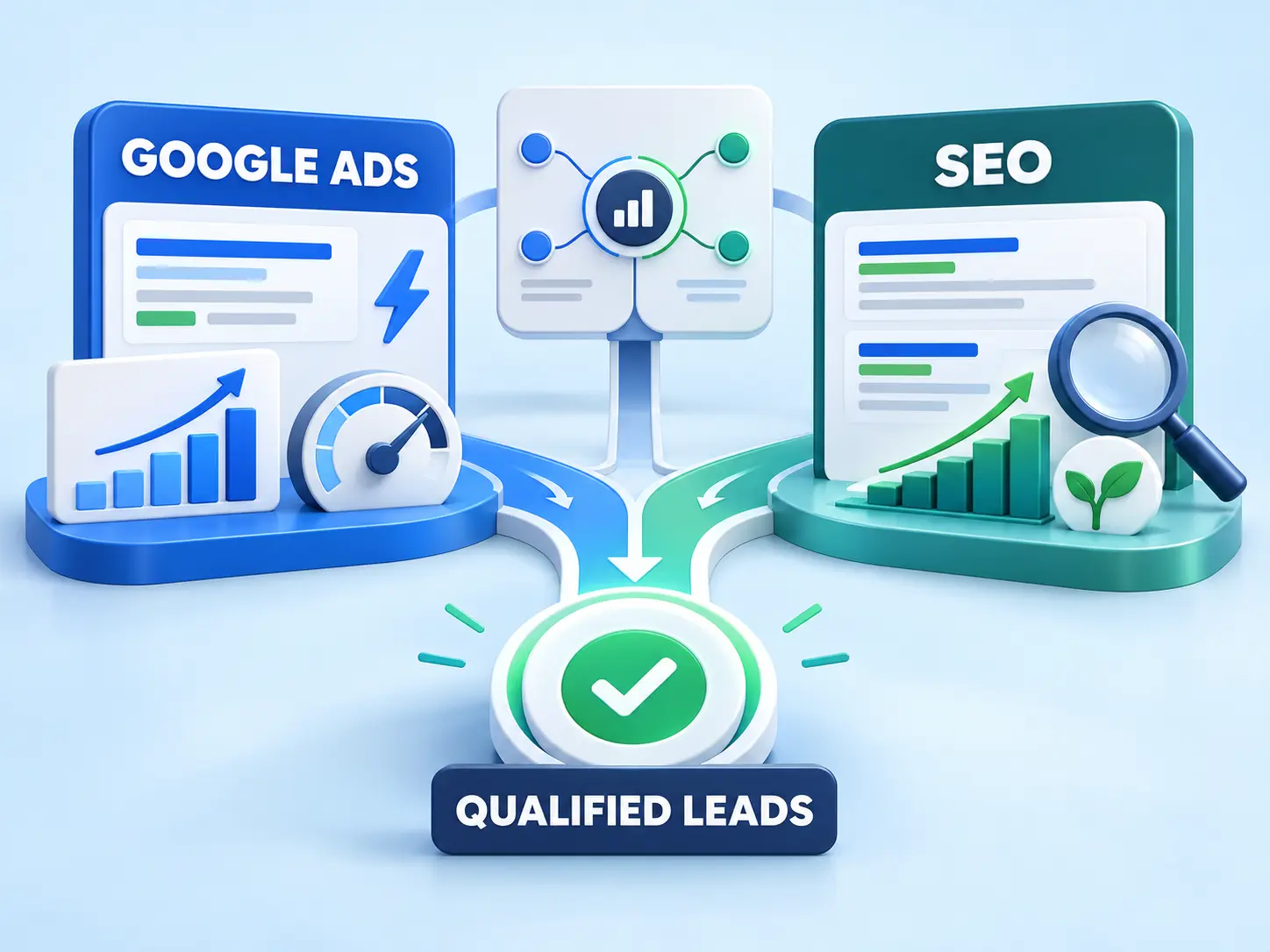
For most San Diego businesses, the choice is not whether Google Ads or SEO is universally “better.” It is which channel should solve the most important business constraint first. Google Ads is usually the stronger first move when qualified demand must be tested or reached quickly. SEO is usually the stronger first move when the business can invest in durable visibility and already has a proven offer, credible proof, and time for search growth to compound.
Choose Google Ads first when speed, targeting control, and rapid market feedback matter most—and the economics can support paid acquisition. Choose SEO first when valuable searches exist, priority pages can become genuinely competitive, and the business can wait for crawling, evaluation, and ranking changes. Use both when immediate demand and long-term organic growth are both important, but give each channel a defined job and measure qualified leads rather than clicks alone.
Google Ads vs. SEO at a glance
| Decision factor | Google Ads | SEO |
|---|---|---|
| Speed | Can create visibility soon after a well-built campaign is approved and launched | Usually requires time for pages and authority signals to be discovered, evaluated, and reflected in results |
| Control | Direct control over budgets, targeting, schedules, ads, and landing pages | Control over the site and strategy, but not over Google’s ranking systems or timing |
| Cost model | Media spend plus management and landing-page work | Strategy, content, technical improvements, authority building, and implementation |
| Durability | Traffic generally stops when campaigns stop serving | Strong pages can continue earning visibility, although rankings are never permanent |
| Learning | Can reveal search terms, conversion behavior, and offer response relatively quickly | Builds broader evidence about organic queries, pages, authority, and buyer questions over time |
| Best first use | Urgent demand, new offers, controlled tests, or gaps where organic visibility is weak | Durable category visibility, local authority, strong service pages, and lower dependence on paid traffic |
Equity Channel Investment Framework
Urgency + economics + demand + website readiness + measurement + sales capacity
The best starting channel is the one that can produce useful evidence and qualified opportunities without outrunning the business. Evaluate all six factors together. A fast campaign is not a win if the website cannot convert. A page-one ranking is not a win if the query has little commercial value. A lower cost per lead is not a win if the sales team says the leads are unqualified.
Start with the business decision—not the channel
“Should we do Google Ads or SEO?” is often asked too early. First define the result the business needs. Is the immediate problem too few qualified inquiries, an unproven offer, weak visibility for a priority service, dependence on referrals, poor local presence, or traffic that does not convert?
The answer changes the investment. A company with strong margins and an empty sales pipeline may reasonably prioritize speed. A company already receiving steady demand but losing organic market share may prioritize durable search visibility. A company whose forms, calls, or booking paths are broken should fix measurement and conversion before scaling either channel.
When should a San Diego business invest in Google Ads first?
Google Ads management is usually the better first investment when the business needs controlled visibility now and can measure whether the resulting inquiries are commercially worthwhile.
- Demand is time-sensitive. The company has near-term capacity, a seasonal opportunity, a launch, or a pipeline gap that cannot wait for organic growth.
- The offer is proven. The business knows what it sells, who is a good customer, which geography it serves, and what makes the offer credible.
- Customer value can support acquisition cost. Gross profit, close rate, repeat value, and sales capacity leave room for paid clicks and management.
- Search demand already exists. Prospects actively search for the service and the campaign can target meaningful intent.
- A relevant landing page exists. The page clearly continues the ad’s promise, establishes trust, works on mobile, and makes the next step obvious.
- Conversions and lead quality can be measured. Completed forms, qualified calls, and bookings are distinguished from button clicks or other micro-actions.
Google Ads can also be a useful research engine. The search-terms report shows queries that triggered ads and how they performed. That can uncover high-value language, weak intent, negative-keyword opportunities, and landing-page gaps. The learning is valuable only when someone reviews the actual searches and connects them to lead quality.
Google Ads buys participation in paid auctions. It does not buy a higher organic ranking. Google states that inclusion and ranking in its organic results do not cost money. Treat paid and organic search as connected customer-acquisition systems with different mechanisms—not as interchangeable placements.
When should a San Diego business invest in SEO first?
Strategic SEO is usually the better first investment when the company has time to build durable visibility and the website has clear opportunities around commercially important searches.
- Priority services have real search demand. Buyers use Google to compare solutions, providers, costs, problems, and local options.
- The site has near-page-one opportunities. Relevant queries already appearing in positions 5–20 may respond to focused page, internal-link, proof, and authority improvements.
- Paid clicks are expensive or margins are constrained. The business needs a more durable acquisition asset, even though SEO still requires investment.
- The buying cycle depends on trust. Service pages, case studies, reviews, founder expertise, local evidence, and useful guidance can improve both visibility and buyer confidence.
- The business wants broader demand coverage. SEO can address commercial service searches, local searches, comparisons, costs, buyer questions, and supporting informational intent.
- The company can implement consistently. Technical fixes, page improvements, proof, content, and authority building need owners and follow-through.
SEO is not free traffic. It requires strategy, implementation, measurement, and patience. Google’s documentation notes that search changes take time to be reflected; some changes may be noticed relatively quickly, while broader improvements can take much longer. That lag makes SEO a poor emergency lever but a potentially valuable long-term asset.
When should you use Google Ads and SEO together?
For an established San Diego service business, a coordinated approach is often strongest when there is enough budget and operational capacity. The channels should not duplicate work without a reason. Give each a job.
| Business need | Google Ads job | SEO job |
|---|---|---|
| Immediate pipeline | Reach high-intent searches while organic visibility is still developing | Build priority pages and authority so paid media is not the only source of search demand |
| New service | Test query language, geography, offers, and landing-page response | Use validated buyer questions to build durable service and supporting content |
| Competitive category | Compete selectively where the economics are strongest | Strengthen organic relevance, proof, internal links, and third-party authority |
| Local growth | Control paid service-area coverage and campaign schedules | Improve local organic pages, Google Business Profile signals, reviews, and prominence |
| Measurement | Produce fast query and conversion feedback | Track which organic queries and pages create qualified demand over time |
Data can move between the channels without confusing their roles. Paid search terms can reveal language worth investigating organically. Search Console can reveal queries and pages that deserve paid coverage while rankings develop. Landing-page testing can improve the experience for both paid and organic visitors.
Use unit economics before choosing a Google Ads budget
Paid search should be evaluated against the value of a qualified opportunity—not against an arbitrary monthly budget. A useful starting estimate is:
Illustrative unit-economics check
Work backward from gross profit and close rate
The business would normally set a target cost per qualified lead meaningfully below the theoretical break-even level. Actual decisions should account for management fees, media waste, fulfillment costs, cash flow, repeat value, sales time, and the fact that early data is uncertain.
A $500 monthly media budget is not automatically too low or enough. Its usefulness depends on click costs, conversion rate, lead quality, and how much data is needed to make a decision. If the budget buys only a handful of clicks in a competitive market, it may not produce a reliable test. If a narrow local campaign reaches inexpensive, high-intent searches, it may still provide useful evidence.
Evaluate website readiness before funding either channel
Both channels eventually send a person to the website. If that experience is unclear, slow, generic, untrustworthy, or difficult to use on a phone, more visibility can amplify the wrong outcome.
Before increasing spend or publishing more content, inspect the priority landing page for:
- A clear match between the search, the page heading, and the service
- Specific information about who the service is for and where it is available
- Credible proof: reviews, case evidence, expertise, process, and real business details
- A mobile-friendly path to call, submit, or book
- Qualification language that discourages obvious mismatches
- Reliable conversion tracking and tested forms
If these elements are weak, prioritize landing-page and website improvements alongside the chosen acquisition channel. Traffic is only useful when the page helps the right visitor understand, trust, and act.
Measure qualified outcomes, not channel vanity metrics
Google Ads and SEO produce different platform metrics, but the business objective should converge. Impressions, clicks, click-through rate, average position, cost per click, and conversion volume can diagnose performance. They do not prove business value by themselves.
A practical measurement hierarchy is:
- Qualified leads, booked appointments, sales opportunities, and revenue
- Completed calls, forms, or bookings tied to the correct landing page and channel
- Conversion rate and cost per qualified lead
- Commercial query and priority-page growth
- Clicks and engaged visits
- Impressions and visibility
Micro-conversions such as button clicks or booking starts can reveal friction, but they should not be reported as completed leads. When possible, return lead dispositions or customer value to the advertising and analytics systems so optimization is informed by quality rather than raw volume.
Three practical 90-day investment paths
| Path | Days 1–30 | Days 31–60 | Days 61–90 |
|---|---|---|---|
| Google Ads first | Confirm economics, tracking, landing page, geography, campaign structure, and negative-keyword baseline | Review search terms and lead quality; improve ads, targeting, exclusions, and page message match | Shift budget toward qualified demand; document which services, queries, and locations justify expansion |
| SEO first | Baseline Search Console, rankings, conversions, technical issues, priority pages, competitors, and authority | Improve the highest-value service pages, internal links, proof, and local relevance; resolve indexing barriers | Build supporting content and credible authority; assess movement by query, page, and qualified action |
| Coordinated | Launch a controlled paid test while fixing the same priority landing page and SEO foundation | Use paid-query and conversion evidence to refine the page; strengthen organic relevance and authority | Reallocate by lead quality, defend valuable gaps with paid search, and expand organic work that shows traction |
Common Google Ads vs. SEO mistakes
- Choosing from ideology. “Ads never work” and “SEO is too slow” are not business cases.
- Starting both without enough resources. Two underfunded, unmeasured programs can create less learning than one focused test.
- Sending every search to the homepage. High-intent visitors need a page that directly answers the search and supports the next step.
- Treating every form as a good lead. Spam, job inquiries, vendors, wrong locations, and poor-fit requests distort channel decisions.
- Stopping SEO after publishing. Important pages need internal support, proof, technical quality, authority, and measured improvement.
- Letting Ads run without search-term review. Keywords are not the same as the actual queries that trigger ads.
- Making permanent decisions from a short test. Seasonality, limited conversions, sales follow-up, and tracking errors can create false conclusions.
Frequently asked questions
Is Google Ads better than SEO?
Neither is universally better. Google Ads is stronger for speed and targeting control. SEO is stronger for building durable organic visibility. The best choice depends on the business constraint, economics, search demand, website, measurement, and time horizon.
Which works faster: Google Ads or SEO?
Google Ads usually creates visibility faster because eligible campaigns can participate in paid auctions after launch. SEO changes require Google to crawl, process, and evaluate pages and other signals, so meaningful growth usually takes longer.
Should a small local business use both?
Use both only when the business can fund, manage, and measure both. A smaller business may learn more by starting with the channel that addresses its biggest constraint, then adding the other once the offer, landing page, tracking, and lead-handling process are reliable.
Can SEO replace Google Ads?
SEO can reduce dependence on paid traffic for some searches, but it cannot guarantee rankings or cover every market gap. Ads can provide controlled visibility for priority searches, launches, seasons, and areas where organic visibility is still weak.
How should a San Diego business decide?
Score both options against urgency, customer economics, actual search demand, current organic position, landing-page quality, conversion tracking, lead quality, and sales capacity. Choose the first 90-day plan that can produce the clearest commercial evidence without creating more demand than the business can serve.
What should you invest in first?
If qualified demand is urgent, the offer and landing page are ready, and the numbers can support paid acquisition, begin with a controlled Google Ads program. If the business has time, commercially valuable search opportunities, and the capacity to improve pages and authority, begin with strategic SEO. If both needs are real, coordinate them around the same services and conversion goals rather than running two disconnected programs.
A Visibility Review can identify which constraint is actually closest to revenue: missing paid coverage, weak organic visibility, the wrong landing page, poor tracking, thin authority, or a conversion path that loses qualified visitors.
Continue the decision: Review what professional Google Ads management should include, learn how to prioritize website pages, or see why ranking and being chosen are different problems.
Primary sources
- Google Ads Help: About the search terms report
- Google Ads Help: About conversion measurement
- Google Ads Help: Conversion value best practices
- Google Search Central: SEO Starter Guide
- Google Search Central: Site position in Search FAQ
Google controls its advertising auctions and organic search systems, and neither channel guarantees a specific cost, ranking, lead volume, or revenue result. Examples above are planning illustrations, not forecasts.